| Longevity Daily |
Wed · May 20 |
|
|
Correction
Monday's edition linked to the Blood Work Cheat Sheet with a broken link. Here is the working one: the Blood Work Cheat Sheet. Apologies for the dead end.
|
|
|
|
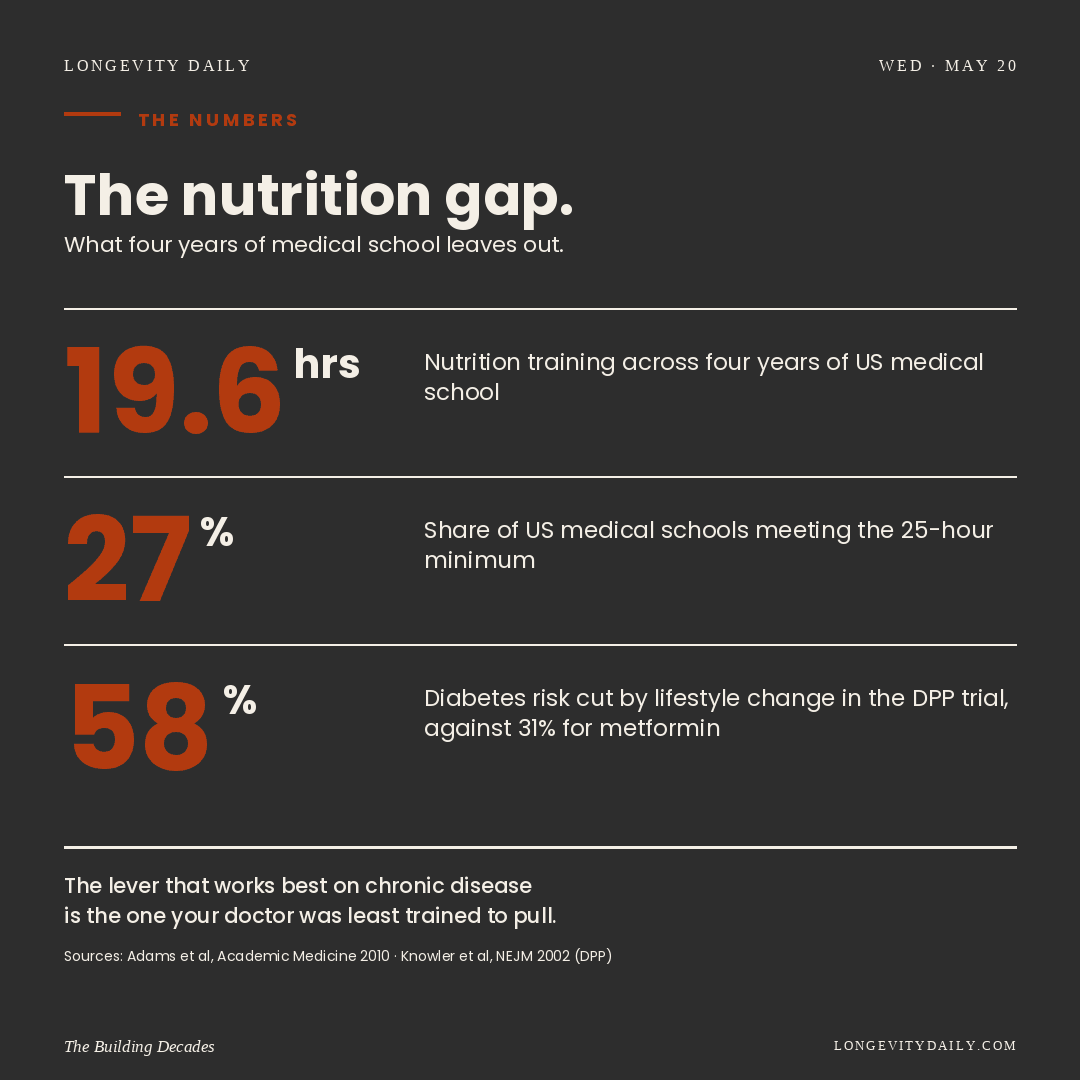
Your doctor spent four years in medical school. Across all four, the average graduate received 19.6 hours of nutrition training. Not 19.6 hours a year. 19.6 hours, total.
That figure comes from a national survey of US medical schools. It was 22.3 hours in 2004, which means nutrition education has been shrinking, not growing, even as diet-driven disease became the single biggest reason people see a doctor at all.
This is not a knock on your doctor. It is a structural fact about how medicine is taught. Doctors are trained, intensively and well, to diagnose disease and to prescribe for it. They are barely trained in the thing that prevents most of what they diagnose. So when you ask the diet question and get a vague answer, that is not indifference. That is the curriculum. Call it the nutrition gap, and understand what it means: for the conditions most likely to shape your next thirty years, you have to drive the conversation yourself.
|
|
|
Tap and hold to save the numbers.
|
What The Research Actually Says
|
|
The 19.6-hour figure comes from Adams et al, a 2010 national survey of US medical schools published in Academic Medicine. It found that only 27 percent of schools, 28 out of 105, met the minimum 25 hours of nutrition instruction recommended decades earlier by the National Academy of Sciences. The average had dropped from 22.3 hours just six years before. Nutrition was not holding steady in the curriculum. It was being squeezed out, year by year.
This is not only a US problem. A 2019 systematic review in The Lancet Planetary Health, by Crowley, Ball, and Hiddink, pooled studies from medical schools across the United States, Europe, the Middle East, and Australasia. The finding was consistent everywhere it looked: nutrition is insufficiently taught, and medical students themselves report finishing their training without the confidence to counsel a patient on what to eat. The gap is not an American quirk. It is built into the model.
Here is why that matters. The Diabetes Prevention Program, Knowler et al, New England Journal of Medicine 2002, randomised 3,234 adults at high risk of type 2 diabetes into three groups: placebo, the drug metformin, or an intensive lifestyle program built on modest weight loss and 150 minutes of walking a week. Lifestyle change cut diabetes risk by 58 percent. Metformin cut it by 31 percent. In absolute terms, the lifestyle program dropped three-year diabetes incidence from roughly 29 percent to roughly 14 percent. The number needed to treat was about seven: work with seven high-risk adults on diet and movement for three years, and you prevent one case of diabetes outright. The lifestyle arm beat the drug, head to head, and it was not close.
|
The lever that works best on the disease your doctor diagnoses is the one your doctor was least trained to pull.
|
|
|
|
The Bottom Line
|
|
None of this means skip the doctor. Diagnosis, screening, acute care, the conditions that genuinely need medicine: that is what they trained for, and they are very good at it. The mistake is expecting the same training to cover food, movement, and sleep at any real depth. It was never in the syllabus.
So do not try to argue nutrition with your GP. Ask them instead to route you to someone whose entire profession is the thing their training skipped. A registered dietitian gets years of exactly the education your doctor got 19.6 hours of. The referral takes one sentence, and most insurance plans cover several sessions a year.
|
| The Action |
|
Ask for a referral to a registered dietitian. Those exact words, at your next visit. The referral costs your doctor one sentence, and most plans cover several sessions a year.
|
|
The nutrition gap is real. A registered dietitian is how you close it.
|
|
Friday Preview
|
|
Friday's edition: three things we learned this week, and the one worth doing before Monday. A grip-strength number, a sleep-timing finding, and a supplement that earned its place.
|
| Until Friday. |
| Longevity Daily · The Building Decades |
| Share this edition with someone who'd find it useful. |
| Instagram: @longevitydaily_ · Subscribe |
|
|