Three things we learned this week, and one to try while no one is watching.
The pattern across all three is the same. The wellness internet sells direction. The cohort data sells dose. The dose is what moves the needle.
|
|||
| This weekend's minimum effective dose: ten minutes of outdoor light in the first hour after waking. No glass, no sunglasses, no coffee first. Then lamps only after sunset. | |||
| Sources: Saint-Maurice et al, JAMA 2020 · Reynolds et al, The Lancet 2019 · Wright et al, Current Biology 2013 |
1. Five hours, across four buckets.
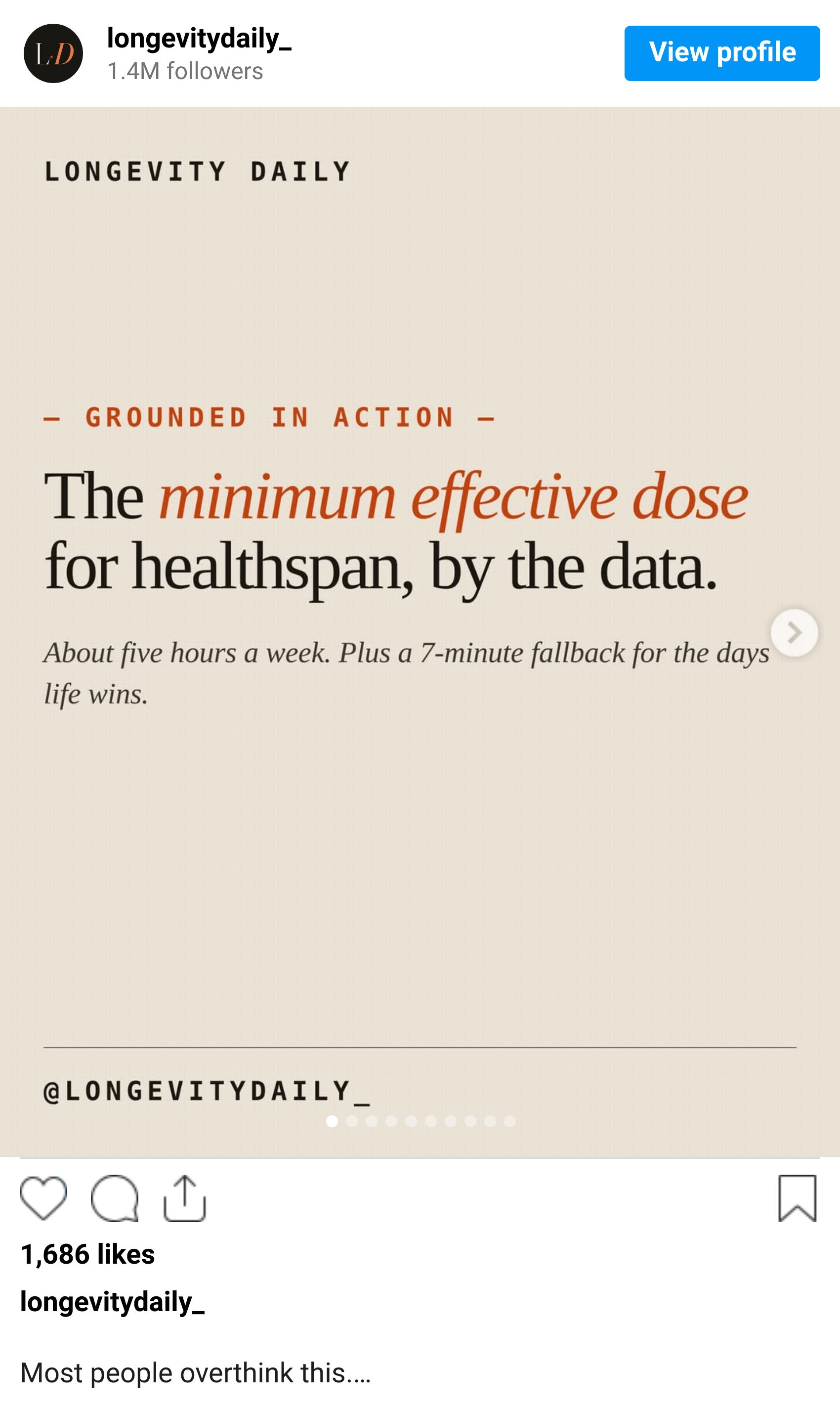
The "five hours of zone 2" framing we put into circulation earlier this week was incomplete. The cohort data is actually on the split, not the total. The four buckets that move the longevity needle are two heavy lifts a week (~90 minutes), two to three zone 2 sessions (~150 minutes), one weekly HIIT 4 by 4 (~30 minutes), and 7,000 to 10,000 steps a day. Roughly five hours of structured movement, four different exposures.
Each lever pulls a different curve. Saint-Maurice et al, JAMA 2020 tracked 4,840 US adults for a decade and showed an 8,000-step day was associated with 51 percent lower all-cause mortality versus a 4,000-step day. Stamatakis et al, Nature Medicine 2022 followed 25,241 non-exercisers via wearables and found three short vigorous bursts a day, one to two minutes each, produced 38 to 49 percent lower mortality. Different bucket. Same direction. The cohort data is unusually consistent on this.
The weekly breakdown is here.
2. 30 grams. 40 grams. 30 plants.
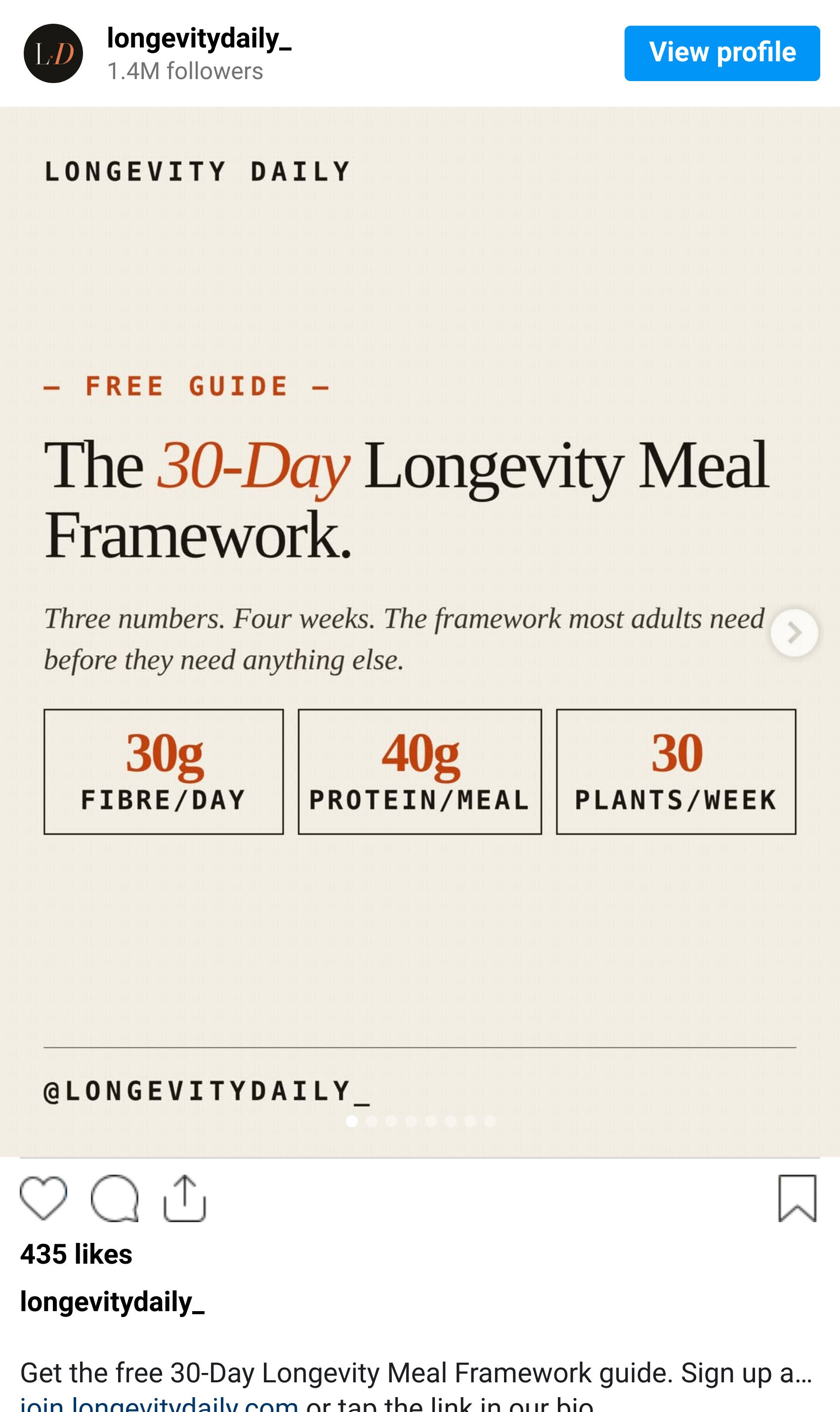
Three numbers most adults need to hit before they need a single supplement. 30 grams of fibre a day, 40 grams of protein per meal, 30 distinct plants a week. Reynolds et al, The Lancet 2019 pooled 185 prospective studies and 58 trials, 135 million person-years of data, and found 25 to 29 grams of daily fibre was the threshold where all-cause and cardiovascular mortality dropped 15 to 30 percent. The average adult gets about half that.
This is the framework Monday’s deep dive was built around. Diets don’t fail. Your biology does. The framework lasts because the dose is sustainable. Diets fail because the dose is wrong.
The framework card is here.
3. Morning light. Evening dark. Both.
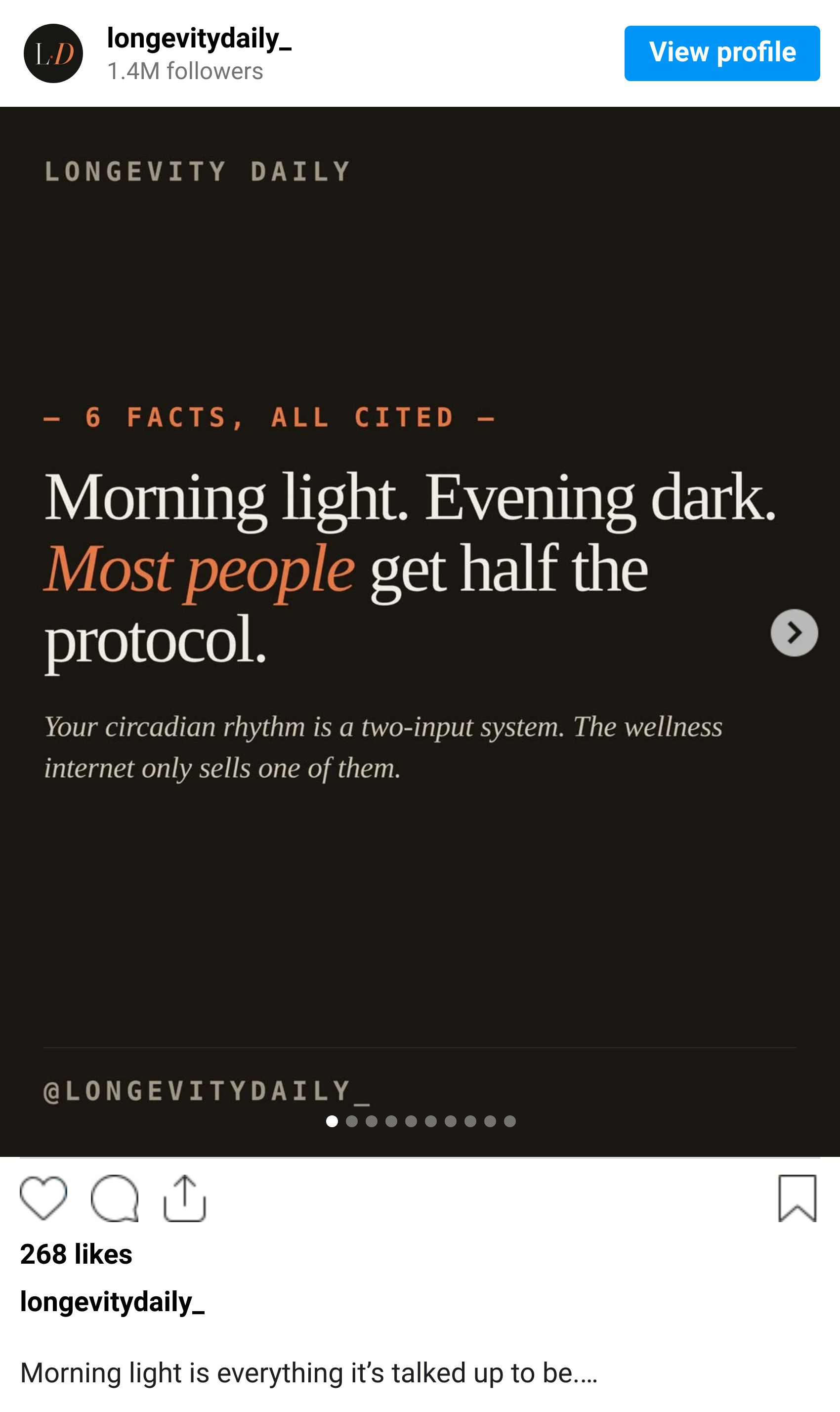
Your circadian rhythm is a two-input system. The wellness internet sells the morning half, the sunrise photo, and quietly ignores the evening half. The data does not.
Wright et al, Current Biology 2013 put eight adults in the Rocky Mountains for a week with no electric light. Their circadian clocks synced to sunrise and sunset inside seven days, regardless of chronotype. Daytime light exposure went up roughly four times. Chang et al, PNAS 2015 ran the inverse experiment, four hours of light-emitting eReader use before bed, and measured melatonin suppressed by 55 percent and REM sleep cut in the same window. Most people run half the protocol. They get the morning light, then erase the gain after sunset.
The protocol card is here.
Your Weekend Action
Run the light protocol for 48 hours. Saturday and Sunday.
Ten minutes of outdoor light in the first hour after waking. No glass, no sunglasses, no coffee first. Then, after sunset, no overhead light at home. Lamps only, low and warm. Phones to night-shift. If you can hold the line, no screens after 9pm at all.
You will sleep differently by Sunday night. How you feel waking up Monday tells you whether it earns a place in the week.
The four buckets and the meal framework are weekly builds. The light protocol is the only one that delivers a felt difference inside 48 hours. Start there.
Monday Preview
Monday’s edition: the bloodwork your doctor probably will not order. Six markers that predict midlife disease better than the standard panel, and how to ask for each by name.
Until Monday.
Longevity Daily
The Building Decades
P.S. Share this edition with someone who’d find it useful.