Longevity Daily Mon · Jun 15

Most adults treat heat as a recovery tool. The Finnish cohort data treats it as a cardiac intervention.

A small Finnish town has tracked 2,315 middle-aged men since 1984. Researchers know how often each man went to the sauna and what he died of. Two decades into the data, the pattern was unmissable. Men who used the sauna 4 to 7 times a week had 50 percent lower fatal cardiovascular disease than men who used it once a week. Sudden cardiac death dropped 63 percent.

These are not biomarkers. These are deaths.

Where Heat Sits
See where heat protocols sit in your top 3 priorities →
Five-minute assessment. Tells you whether sauna is the next lever for your number, or whether something else moves it more. Free, no blood draw.
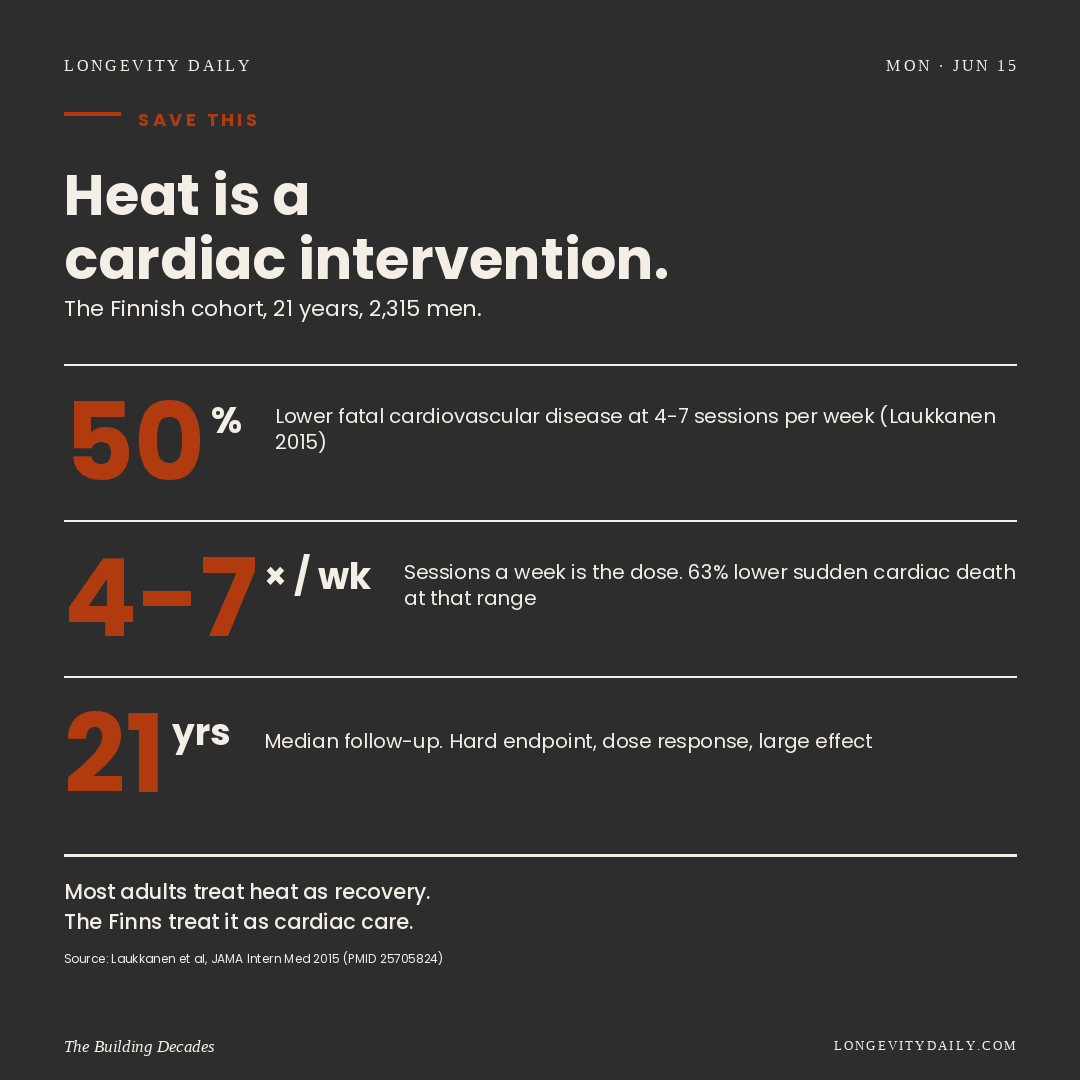
Heat is a cardiac intervention. The Finnish cohort, 21 years, 2,315 men. 50 percent lower fatal cardiovascular disease at 4 to 7 sauna sessions per week (Laukkanen 2015). 63 percent lower sudden cardiac death at that range. 21-year median follow-up. Hard endpoint, dose response, large effect.
Save this. Send it to the person whose gym membership includes a sauna they never use.

The Evidence

The headline study is Laukkanen et al, JAMA Internal Medicine 2015. 2,315 middle-aged men from Kuopio, Finland, ages 42 to 60 at baseline. Researchers tracked sauna habits at the start, then followed deaths for a median of 20.7 years. The cohort grouped men by sessions per week: 1, 2 to 3, or 4 to 7.

The mortality gradient was clean. Compared to men who took 1 sauna a week, men who took 4 to 7 had a 63 percent lower risk of sudden cardiac death and a 50 percent lower risk of fatal cardiovascular disease across the follow-up. All-cause mortality dropped 40 percent. Duration mattered too. Sessions of 19 minutes or longer carried lower risk than sessions under 11 minutes.

These are large effects on a hard endpoint, in a large cohort, over two decades, with a dose response. Few longevity interventions have that combination of qualities outside of resistance training and not smoking.

The mechanism is not heat as relaxation. Sauna bathing raises core body temperature to 38 to 40 degrees Celsius and heart rate to 100 to 150 beats per minute. From the cardiovascular system's point of view that is moderate-intensity aerobic activity. Plasma volume expands. Endothelial function improves. Heat shock proteins increase. Blood pressure falls after each session. The arterial wall, taken through this dose week after week, adapts the same way it would to interval training, with the load coming from heat rather than muscle.

It is not a substitute for exercise. The Laukkanen data still showed exercise was independently protective. The two effects added together. The men who did both lived longest of all.

See where heat sits against your other priorities →

What This Means For You

The protocol that fits the data is unusually specific.

Temperature. 80 to 100 degrees Celsius (176 to 212 Fahrenheit). The Finnish range. Below 80 the heat dose is small. Above 100 most adults cannot tolerate it for the duration.

Duration. 15 to 30 minutes per session. The Kuopio men in the lowest-mortality group sat for 19 minutes or more. Build to it. Start with 10 minutes, add five minutes a session until you settle in.

Frequency. 2 to 7 sessions a week. The dose response in the Finnish data was monotonic. 2 to 3 sessions a week was better than 1. 4 to 7 was better than 2 to 3. There was no apparent ceiling.

Access. Most cities have more sauna access than you might realise. Gym locker rooms, public bathhouses, dedicated sauna studios, hotel day passes, hot yoga spaces. The simplest way to find what is near you:

Find a sauna near you →

Infrared note. Infrared cabins reach 50 to 60 degrees Celsius. The Laukkanen cohort data is on traditional Finnish-style dry-heat sauna at 80 to 100 degrees Celsius. The cohort findings apply to that specific protocol.

The Action
Three sauna sessions this week. 20 minutes each. 80 to 100 degrees Celsius. Traditional dry, not infrared. Use the one in your gym. The dose that mattered in the Finnish data is in reach for most readers, in a building most readers already pay for.
Take the Healthspan Score →

When was the last time you used the sauna in the building you already pay for?


Wednesday Preview

Wednesday's edition stays in recovery. Which version is data and which is sold.

Until Wednesday.
Longevity Daily · The Building Decades
Share this edition with someone who'd find it useful.

Source

Laukkanen et al, JAMA Intern Med 2015 (PMID 25705824)

Follow @longevitydaily_  ·  Subscribe

Recommended for you