| Longevity Daily |
Mon · Jun 8 |
|
|
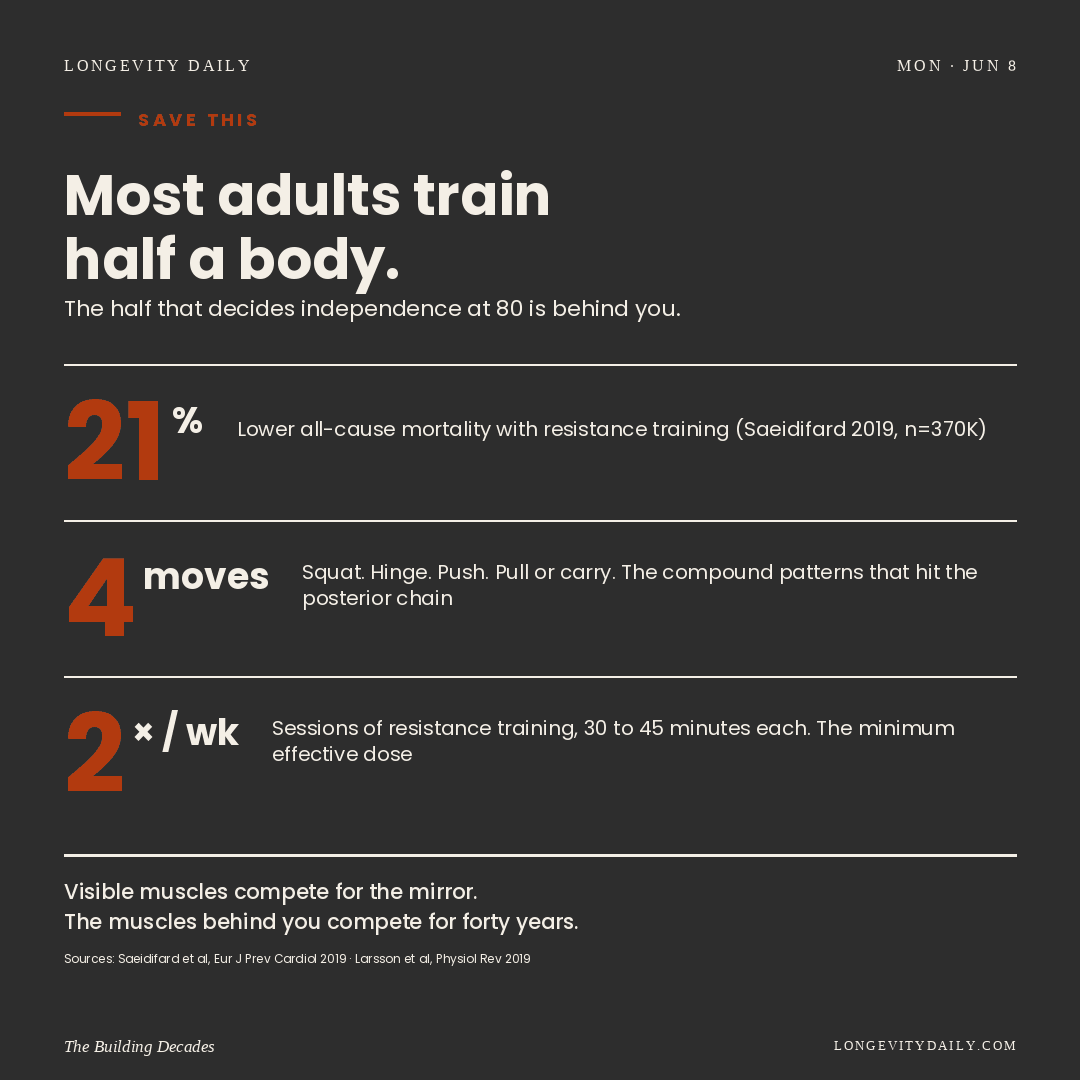
Most adults train half a body. The half they can see.
Chest. Biceps. Abs. The mirror muscles. The internet wrote those into the meaning of "fit" decades ago and the gym followed. Most adults over 30 still train them. Most adults over 50 wonder why their backs ache and their hips will not hinge.
The half that decides the next forty years is the half behind you. Glutes. Hamstrings. Lower back. Calves. Plus grip, and the ability to carry load any distance. None of it looks like the cover of a magazine. All of it is what keeps a person off the floor at 80.
|
| Where Strength Sits |
|
See where strength sits in your top 3 priorities →
|
|
The Healthspan Score takes five minutes and tells you whether resistance training is where the next lever is for you, or whether something else moves your number more. Free, no blood draw, no concierge plan.
|
|
|
|
Save this. Send it to the person who has trained chest and biceps for fifteen years and never hinged.
|
The Evidence
|
|
Muscle mass starts to decline in your 30s. The published rate sits between 3 and 8 percent per decade after age 30, accelerating after 50, with strength decaying faster than mass. By the time anyone notices a problem, the body has already lost a decade of capacity. The mechanism is summarised in the Larsson et al review, Physiological Reviews 2019, which remains the cleanest single source on age-related skeletal muscle decline.
The mortality data on doing something about it is unusually direct. Saeidifard and colleagues, European Journal of Preventive Cardiology 2019, pooled 11 studies covering 370,256 adults across a mean follow-up of nearly nine years. The result. Resistance training alone was associated with about 21 percent lower all-cause mortality. Combined with aerobic exercise it was about 40 percent. The mortality benefit held independent of fitness level at baseline and independent of body composition. It was not muscle mass that predicted living longer. It was the act of training the muscle that did.
The misunderstanding most people have is which muscles to train. Cardiac and metabolic research has spent the last decade catching up to what physical therapists already knew. The most predictive functional capacity in older adults is not bicep size. It is what is called the posterior chain. Glutes do most of the work in getting out of a chair. Hamstrings and lower back do most of the work in lifting anything off the floor. Calves stabilise every gait. And grip strength, the act of holding load, predicts mortality better than blood pressure does in some cohorts.
These four pieces, posterior chain, grip, and carry capacity, are what most gym routines never directly train. They get hit incidentally during compound lifts, sometimes. They are almost never the focus.
|
|
See where strength sits in your top 3 priorities →
|
What This Means For You
|
|
The minimum effective dose is small. Two resistance sessions a week, 30 to 45 minutes each, covering four movement patterns. Squat (or sit-to-stand variant). Hinge (deadlift or hip thrust). Push (press, push-up). Pull (row, pull-up, or carry). One or two sets per pattern, taken close to failure, with the load that lets you finish 8 to 12 reps cleanly.
The fifth thing, sometimes folded into the fourth, is the carry. Loaded carries are the simplest functional movement humans have. Suitcase carry, farmer's walk, or the practical version, a weighted backpack walked at a brisk pace. Twenty minutes of rucking with 10 to 15 percent of your bodyweight covers carry, grip, posterior chain, and zone 2 cardiovascular work in a single block.
What it adds up to: one rucking walk and two resistance sessions a week. Three sessions, about three hours total. Sitting somewhere between the cheapest and the most evidence-supported longevity intervention available to anyone reading this.
This is what creatine is for. Friday we said the one supplement we take without thinking is creatine, and the cognitive data is real. The structural data is older and stronger. Creatine raises the ceiling on resistance training adaptations, particularly in adults over 40 whose recovery is slowing. The supplement is the support. The lift is the lever.
|
| The Action |
|
Two resistance sessions and one loaded carry. This week. Each session hits squat, hinge, push, and pull. Posterior chain gets the most attention. The carry is twenty minutes of rucking at ten to fifteen percent of your bodyweight. Three sessions, about three hours total, the week your eighties begin to be written.
|
|
Take the Healthspan Score →
|
|
|
Which half of your body have you been training, and which half has been training itself?
|
|
|
Wednesday Preview
|
|
Wednesday's edition takes a single test apart. The 30-second test that predicts how independent you will be at 80, with cleaner data than your annual physical. Most adults have never done it. The version most people imagine is the easy one.
|
| Until Wednesday. |
| Longevity Daily · The Building Decades |
| Share this edition with someone who'd find it useful. |
|
|
Sources
Saeidifard et al, Eur J Prev Cardiol 2019 · Larsson et al, Physiol Rev 2019
|
|
Follow @longevitydaily_ · Subscribe
|
|