| Longevity Daily |
Wed · Jun 10 |
|
|
Most adults assume they can sit on the floor and stand back up. Most adults can. Most adults also assume that means they passed the test. The test is harder than the action.
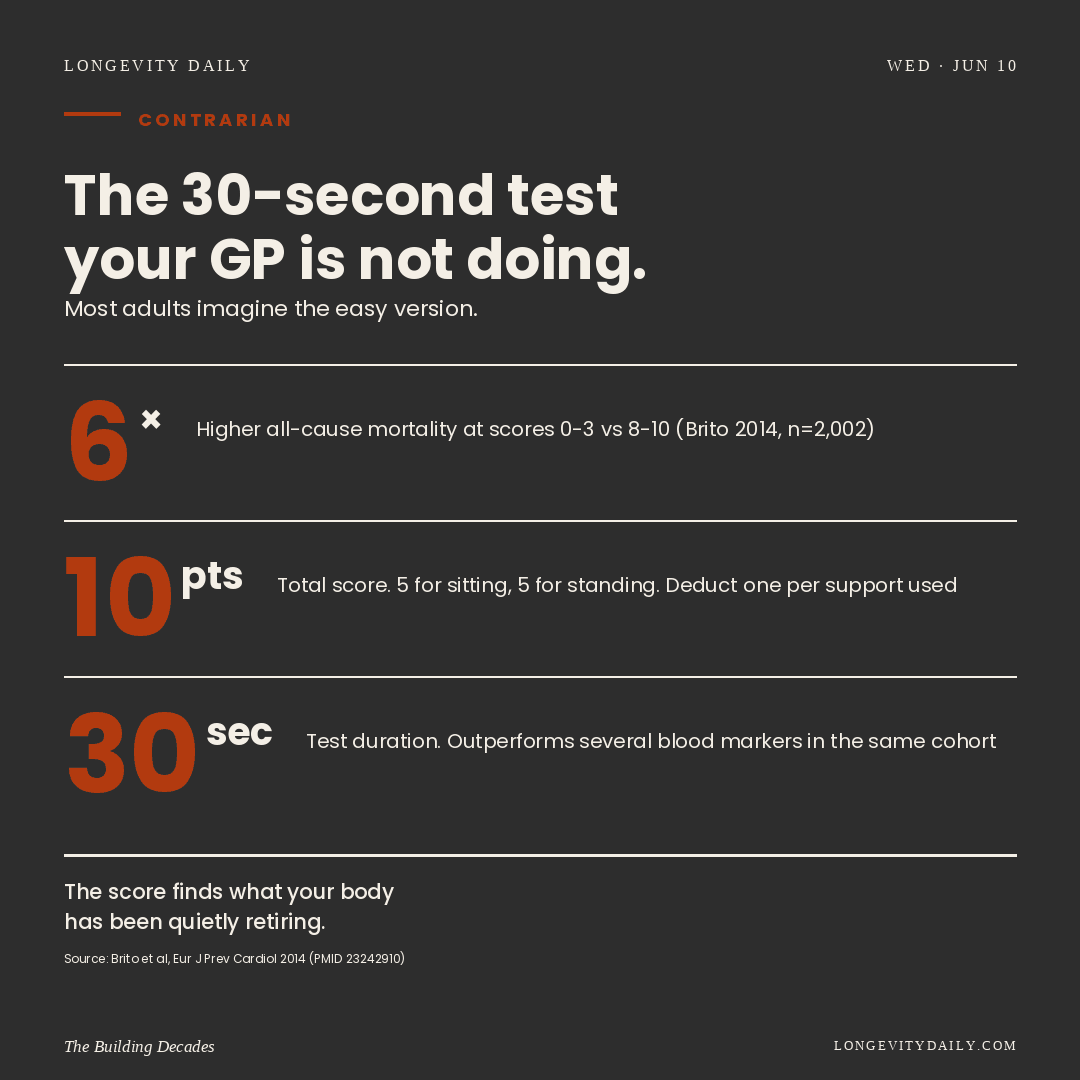
The sitting-rising test is the single best 30-second functional screen in mortality research. The action is simple. Sit on the floor. Stand back up. The scoring is not.
You start with ten points. You lose a point each time you put down a hand, a knee, an elbow, or a forearm. You lose half a point each time you wobble. Most adults imagine the casual cross-legged sit and the lazy stand. The actual scored version finds out what part of your body has been quietly retiring.
|
| Before The Test |
|
See where mobility and strength sit in your top 3 →
|
|
The sitting-rising test scores four systems at once. The Healthspan Score tells you which of those four is most likely the one your number is gated by. Eight minutes, free, no blood draw.
|
|
|
|
Save this. Send it to the person who confidently said they could sit on the floor without thinking about it.
|
What The Research Actually Says
|
|
The headline study is Brito et al, European Journal of Preventive Cardiology 2014. Over 2000 adults aged 51 to 80 took the sitting-rising test once, then were tracked for a median of 6 and 1/3 years.
The mortality gradient was unusually clean. Adults scoring 8 to 10 served as the reference group. Those scoring 0 to 3 carried about six times the all-cause mortality risk across the follow-up window. The relationship was monotonic. Each additional point on the scale was associated with a measurable reduction in mortality. The test ran from a single screening visit, took thirty seconds, and outperformed several blood markers in the same cohort.
The mechanism is what makes it useful. Most functional tests measure one thing. A grip dynamometer measures grip strength. A treadmill measures aerobic capacity. The sitting-rising test runs four systems at once: lower body strength, hip and ankle mobility, postural balance, and proprioceptive control. None of those four can be faked. All four decay independently as adults age. The score is gated by whichever is weakest.
That is the part most adults underrate. The reason the casual cross-legged sit feels easy is that you compensate. A hand on the floor. A shifted hip. A dragged knee. The scoring system strips those compensations away. The score that comes out is the score of what your body can actually do without negotiating.
|
|
See which of the four is the system your score is gated by →
|
The Bottom Line
|
|
Try the test now. Pick a clear floor space. Stand. Sit cross-legged on the floor without putting down a hand or a knee. Stand back up the same way. Count deductions honestly. A wobble that requires you to put down a hand to steady yourself is a deduction. A hand to balance is a deduction. A knee to load the stand is a deduction.
What the score says. Eight to ten is the reference group. You are in the cohort that lived. Five to seven is the middle band. You can train it up in eight weeks. Zero to four is the alarm bell. Not because four is bad in isolation. Because four at 45 is a different signal than four at 75. If your floor mechanics decayed earlier than your age band predicts, you have a window most adults miss.
Improving the score is not complicated. Hip flexion (the deep squat practice). Hip extension (the hinge from Monday). Single-leg balance (any standing drill held for 30 seconds, eyes open then closed). Loaded carries to build trunk control. The same four-pattern resistance training Monday described, plus mobility for ankles and hips, moves most adults from a five to a seven in six to eight weeks.
|
| The Action |
|
Try the test. Note the score. Train the weakest of the four. One mobility block this week, two of the resistance sessions from Monday. Retest in two months. The number moves faster than most adults expect.
|
|
Take the Healthspan Score →
|
|
|
Which of the four systems is the one your score is gated by?
|
|
|
Friday Preview
|
|
Friday's three. Three movement tests that predict your eighties better than your annual physical. Grip strength. Single-leg balance. The one you took today. Plus the one we still have not done ourselves, and what we found when we did.
|
| Until Friday. |
| Longevity Daily · The Building Decades |
| Share this edition with someone who'd find it useful. |
|
|
Source
Brito et al, Eur J Prev Cardiol 2014 (PMID 23242910)
|
|
Follow @longevitydaily_ · Subscribe
|