A friend comes back from a trip to Panama and tells you they had stem cells injected into a bad knee, and they’ve never felt better. Someone else you know has started booking sessions in an oxygen chamber.
These used to be hospital treatments. Now longevity clinics offer them, along with plasma exchange, with the promise of more good years: moving well, staying sharp and keeping your independence. The truth is, it's hard to tell what you'd be paying for.
Stem cells have the clearest quality-of-life result so far: frail older adults could walk further 9 months later. For sore knees, they did no better than a steroid injection. Plasma exchange and oxygen chambers have improved blood markers in small studies, but nobody has tested yet whether that means feeling or functioning better.
These are the last of this week's extras, and the image below ranks all 11 on one page.

1. Plasma exchange
Think of it as an oil change for your blood. Plasma is the yellowish liquid that makes up a bit over half of your blood. It carries your blood cells around, along with proteins, hormones and waste.
Your blood runs through a machine that separates the plasma from the cells. You get your own cells straight back, and the old plasma is thrown away and swapped for a fresh fluid made of saline and albumin, the main protein in plasma. Hospitals already use it for some immune conditions.
In 42 healthy adults over 50, a course of sessions was safe, and 15 different measures of biological age improved compared with a placebo procedure.
The people who started in poorer health improved the most.
A younger reading on a blood test may not mean more good years. That hasn't been tested, and 42 people is a small trial.
David Furman of the Buck Institute, the trial's senior author, called it a first step in showing that plasma exchange can improve how the body ages. The trial was funded by Circulate, a plasma exchange company he's a member of.
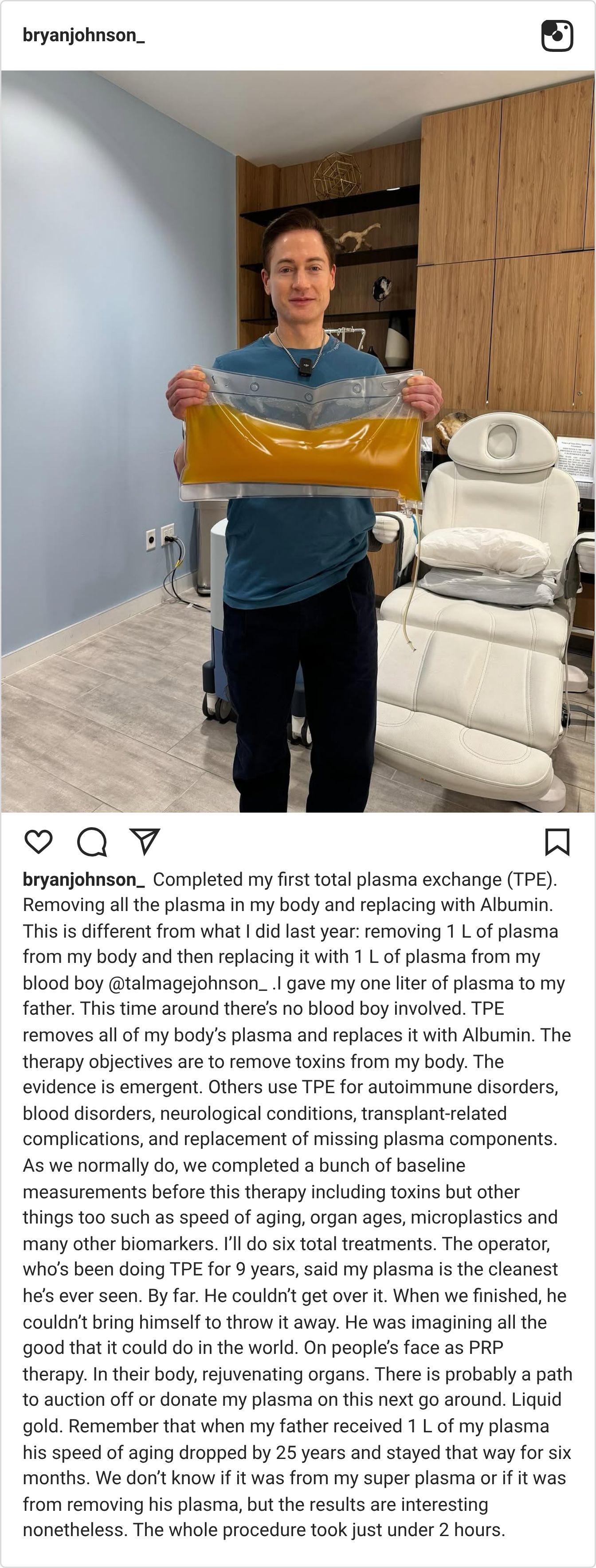
Bryan Johnson, the tech founder known for his anti-aging program, posted this after his first plasma exchange in 2024.
2. Stem cells
Most people come across stem cells as a fix for a sore knee. The idea is that the cells calm inflammation and help tissue repair.
For knee arthritis, a trial of 480 people in Nature Medicine found 3 kinds of cell injection worked no better than a steroid injection after a year.
For frailty the results were better. In 148 frail men and women aged 70 to 85, those given a drip of donor bone marrow cells could walk about 208 feet (63m) further in 6 minutes than the placebo group 9 months later.
In the US, the only stem cell products the FDA has approved are made from cord blood and are for blood disorders. If stem cells interest you, a registered clinical trial is the way to get them.
3. Hyperbaric oxygen
You lie in a pressurized chamber and breathe pure oxygen. The pressure is about what you'd feel 33 feet (10m) underwater. It's a long-standing hospital treatment for wounds that won't heal and for divers with decompression sickness.
In 35 healthy adults aged 64 and over, 60 daily sessions lengthened telomeres, the protective caps on your chromosomes, by more than 20% in immune cells. The number of worn-out T helper cells fell by 37%.
Each session was 90 minutes, which adds up to 90 hours in the chamber.
Everyone in the study had the treatment, so there was no comparison group.
Whether those blood changes help you feel or function better years later is still unknown.
Shai Efrati, the Israeli professor who led that trial, told The New York Times in March that his results are being stretched too far. "I would never use the word longevity," he said. He added that the soft-shell chambers sold for home use can't reproduce the conditions in his studies. The same article put 60 sessions at $6,000 or more.
Where to start
Here’s how to approach these in your protocol.
Start with slow breathing. 5 minutes a day, and it's free.
Add sauna if you have access to one. 2 or 3 sessions a week.
Use meditation, red light or a Nuropod for a specific problem: meditation for anxiety, red light for skin and sore knees, and the Nuropod for stress or sleep.
Consider NMN if it fits your budget.
Talk to a doctor about rapamycin or metformin.
Read up on today's 3 if they interest you.
Most of these 11 have been studied for how you feel and function, which is what healthspan is about. Sauna is the only one that's also been linked to living longer.
The 10 guides in the Longevity Library cover the basics that all of these sit on top of.
The Week in Longevity
Five studies worth 30 seconds each.
01 · RAPAMYCIN
40 inactive adults aged 65 to 85, about half of them women, took rapamycin or a placebo once a week for 13 weeks while following the same home exercise program.
Both groups got stronger. The rapamycin group did no better on the chair-stand test and reported more minor side effects, 99 against 63. It was small and short, so it needs repeating. Read the study →
02 · COLD WATER
The review covered 4,105 adults and looked at mood, stress, wellbeing and depressive symptoms.
Results generally leaned in favor of cold water. The effects got smaller in the better-controlled studies, and most studies were rated at high risk of bias. Anxiety showed little consistent benefit. Read the study →
03 · ANXIETY
A Brown University team pooled 8 trials covering 1,012 adults with generalized anxiety disorder.
Anxiety fell about as much with the course as with escitalopram (Lexapro) in the 2 trials that compared them. It's a preprint, so it hasn't been peer reviewed yet. Read the study →
04 · FRAILTY
47 frail adults in Spain, average age 80, got 6 months of supervised exercise and a nutritional supplement, or their usual care.
Frailty scores, grip strength and walking speed all improved in the exercise group. One of 5 biological age measures improved too. Read the study →
05 · BRAIN
44,488 adults aged 60 and over from 3 long-running studies were followed for 6 to 8 years. 3,492 developed dementia.
A fall went with a 70% higher risk of dementia. The most active people had less than half the risk of the inactive, whether or not they'd fallen. It's observational, so it shows links, not cause. Read the study →
Which of this week's 11 have you tried? Hit reply and tell us. We read every one.
Until Monday.
Longevity Daily / The Building Decades
P.S. Know someone thinking about a longevity clinic? Forward this to them. And tell us what you thought of this week in the poll below.