| Longevity Daily |
Wed · Jun 17 |
|
|
Most adults treat recovery as something you buy. A foam roller in the closet, a percussion gun in the gym bag, a compression boot rented and forgotten, an ice bath in the garage. The category sells over two billion dollars in promises a year.
The data is on something cheaper, harder to package, and uncomfortable to admit. Recovery is something you do, not something you buy. The two moves the published cohort data actually supports are both free, both behavioural, both nearly invisible to the wellness internet.
|
|
|
|
|
Save this. Send it to the person who buys a recovery tool every quarter.
|
What The Research Actually Says
|
|
Two cohorts. Both decades of follow-up. Both endpoints that matter.
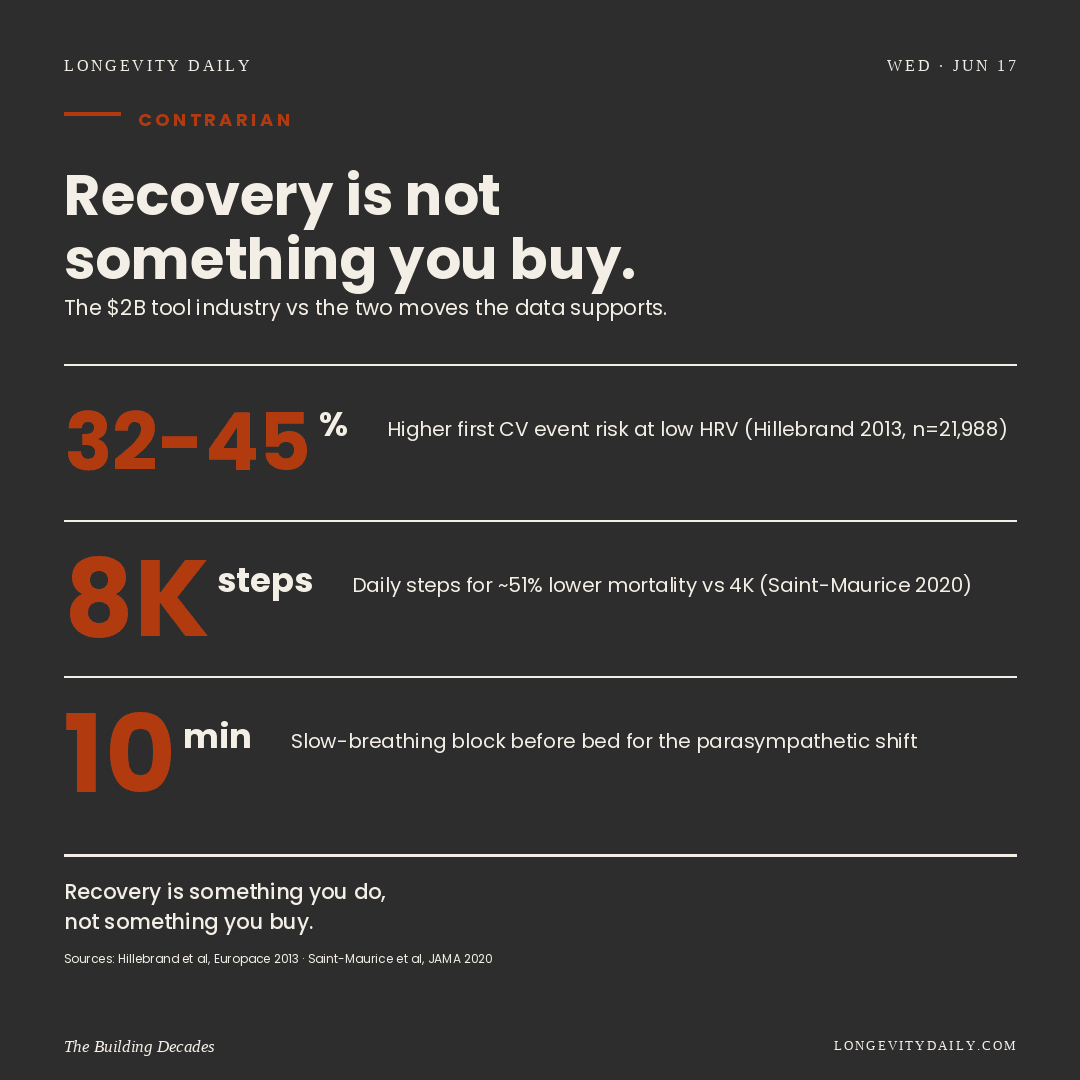
The first is autonomic. Hillebrand et al, Europace 2013, pooled 8 prospective studies, 21,988 adults with no known cardiovascular disease at baseline. Low heart-rate variability, the simplest marker of how much of your day your nervous system spends in parasympathetic versus sympathetic dominance, carried a 32 to 45 percent higher risk of a first cardiovascular event. The relationship was dose-responsive. Each 1 percent gain in HRV (specifically SDNN) was associated with roughly 1 percent lower risk of fatal or non-fatal CVD.
HRV is not something a foam roller moves. It is moved by what your nervous system does during the day. A short walk in daylight after a stressful hour. A 10-minute slow-breathing block before bed. Heat exposure several times a week, which we covered Monday. The recovery-tool industry sells things you apply to your body. HRV is moved by what you do with your day.
The second is mechanical. Saint-Maurice et al, JAMA 2020, 4,800 US adults from the NHANES cohort, wore accelerometers for a week, were followed for mortality through 2015. The relationship between daily steps and all-cause mortality was dose-dependent. Adults taking 8,000 steps a day had about 51 percent lower mortality risk than adults taking 4,000. 12,000 steps was lower still. Step intensity did not add additional benefit after adjusting for total steps. The signal was volume, not pace.
What the data does not show is mortality benefit from passive recovery tools. The recovery-tool category, despite the size of the spend, does not have an equivalent cohort. The acute effects of foam rolling and percussion massage on soreness are real and small. The chronic effects on the endpoints that matter (mortality, cardiovascular events, all-cause aging) are not in the published literature.
|
|
See whether the two moves are the lever for you →
|
The Bottom Line
|
|
Two moves this week. Both behavioural. Both free.
The first, total daily steps. Saint-Maurice's gradient is steepest between 4,000 and 8,000 steps a day. If you sit at 4,000, the easiest single change is a 20-minute walk you can split into two 10-minute walks. Phone walk after lunch. Outdoor block after dinner. The pace does not need to be fast. The number that matters is total.
The second, a parasympathetic downshift before bed. 10 minutes of slow breathing, any 4-second-in 6-second-out pattern, in a quiet space with the lights low. The aim is to drop heart rate by 10 to 15 beats per minute before you lie down. Most wearables with HRV (the picks from Friday) show this directly the next morning as a higher HRV reading.
If you bought a recovery tool and use it, use it. None of the above suggests throwing it away. The category does not appear to harm. It just does not appear to do what the marketing promises on the long-term endpoints. The two moves above are what the data does support, and they cost nothing.
|
| The Action |
|
A 20-minute walk and 10 minutes of slow breathing. Today. Walk after lunch or dinner, not on a treadmill. Breathe before bed, lights low, 4 seconds in, 6 seconds out. Both are free. Both are the moves the cohort data supports. Neither one is in your closet.
|
|
Take the Healthspan Score →
|
|
|
If you spent the last year buying recovery instead of doing it, which move below has the lowest cost to start?
|
|
|
Friday Preview
|
|
Friday's three for recovery week. Three things you can do daily, all behavioural, all free, all in service of the same nervous system the cohort data measures.
|
| Until Friday. |
| Longevity Daily · The Building Decades |
| Share this edition with someone who'd find it useful. |
|
|
Sources
Hillebrand et al, Europace 2013 · Saint-Maurice et al, JAMA 2020
|
|
Follow @longevitydaily_ · Subscribe
|
|