| Longevity Daily |
Wed · Jun 3 |
|
|
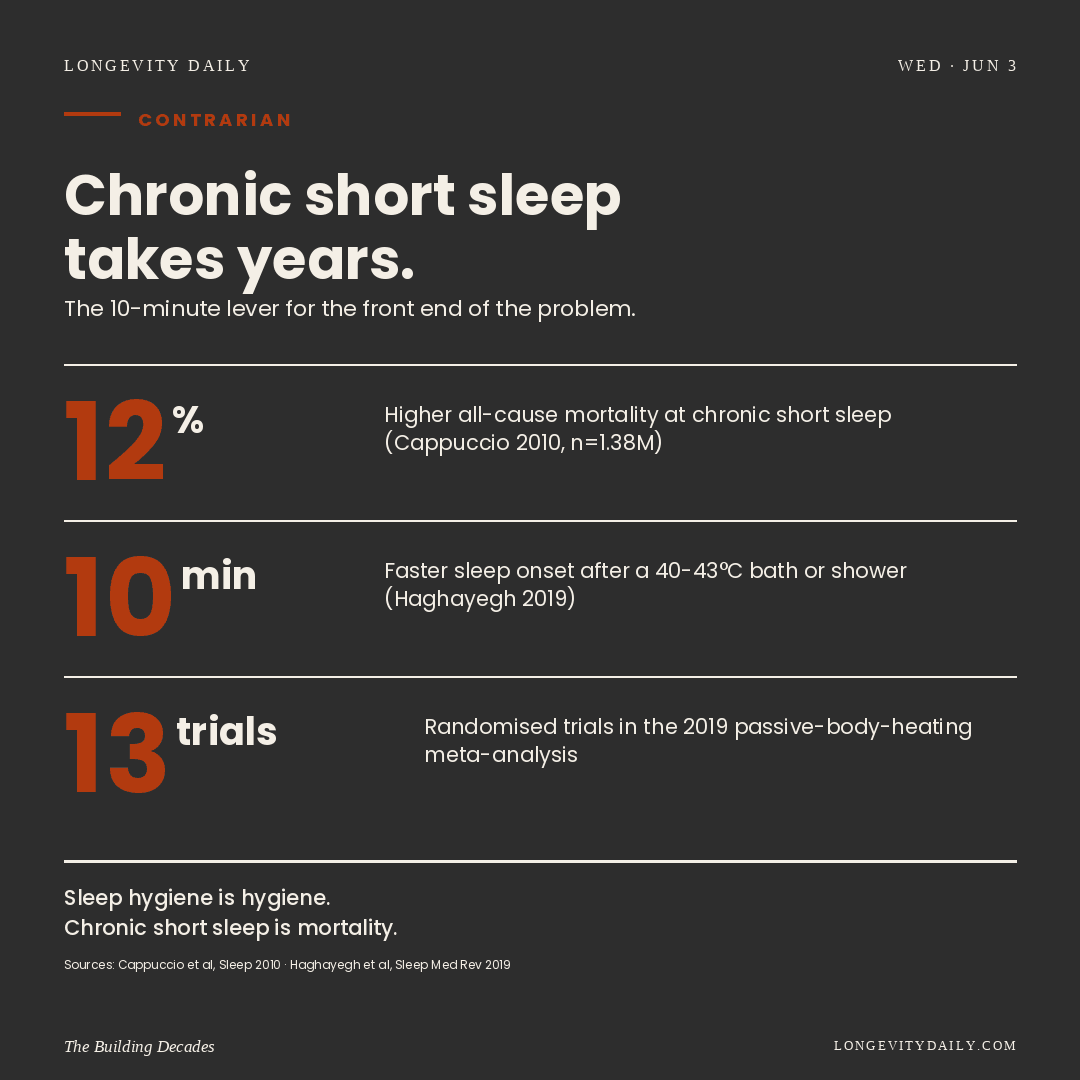
Chronic short sleep is associated with about 12 percent higher all-cause mortality. The number comes from a 2010 meta-analysis of sixteen prospective studies, 1.38 million people. It is one of the cleanest population estimates in sleep epidemiology.
Most sleep advice does not act on it. Most sleep advice is sleep hygiene. The caffeine cutoff, the dim room, the white noise app, the pre-bed reading. All of them help at the margins. None of them moves the number that controls the front end of the problem, how long it takes you to fall asleep once the lights go out.
That number is sleep onset latency. Most adults sit between 15 and 30 minutes. Add 15 minutes of latency on top of an already short window, four nights a week, across a decade, and the chronic-short-sleep mortality curve is the lower bound of the cost.
One intervention moves latency cleanly. It dropped average sleep onset by about ten minutes across a 2019 meta-analysis of thirteen randomised trials. It does not require a wearable, an app, or a supplement. It requires a shower.
|
|
|
|
|
Save this. Send it to the person who reads ten sleep tips a week and falls asleep slower than they used to.
|
What The Research Actually Says
|
|
Two studies frame this.
The mortality stake comes from Cappuccio et al, Sleep 2010, a meta-analysis of 16 prospective cohort studies covering 1,382,999 adults. Short sleepers, in this dataset typically those reporting six hours or less per night, carried about 12 percent higher all-cause mortality across the follow-up than seven-hour sleepers. The relationship was roughly U-shaped. Long sleep carried risk too, for different reasons. The short-sleep tail is the one that compounds.
The lever comes from Haghayegh et al, Sleep Medicine Reviews 2019, a systematic review of 5,322 candidate articles, narrowed to 17 included studies, narrowed again to 13 randomised trials with comparable quantitative data. The intervention: pre-bedtime passive body heating by warm shower or warm bath, against a no-bath control. The pooled finding sat in a tight band. Water at 40 to 43 degrees Celsius, lasting around ten minutes, run 1 to 2 hours before bed, dropped sleep onset latency by an average of just under ten minutes. Sleep efficiency, the percentage of in-bed time actually spent asleep, improved by a measurable amount.
The mechanism is thermoregulatory and slightly counterintuitive. Your brain initiates sleep against a small drop in core body temperature. A warm shower an hour or two before bed accelerates that drop, by triggering peripheral vasodilation. Blood moves to your hands and feet, heat radiates outward, and your core falls faster. Melatonin rises. Onset gets shorter.
Ten minutes back at the front end is not a sleep hack. It is the easiest single move on the part of the night that most people are losing to the wrong intervention.
|
|
Read the 2019 meta-analysis →
|
The Bottom Line
|
|
The actionable protocol is unusually specific. Hotter is not better. Closer to bed is not better. The window matters.
Water temperature: 40 to 43 degrees Celsius (104 to 109 Fahrenheit). Duration: 10 minutes is sufficient. More does not add. Timing: 1 to 2 hours before bed. 90 minutes is the median across the trials. Mode: shower or bath. Both work. Shower is faster.
This is not what most sleep apps prescribe. The apps lean on what is most visible, the dim room and the late-afternoon caffeine cutoff. Those are not wrong. They are smaller. The bath, run at the right time, is the largest single-night intervention with peer-reviewed support.
|
|
Add this to the routine. Then run the Healthspan Score →
|
| The Action |
|
Lose less life to a slow sleep window. Tonight: warm shower, 40 to 43 degrees Celsius, ten minutes, 90 minutes before bed. Dry off, cool down, go about your evening. The core temperature drop hits roughly 90 minutes later. If you usually take 30 minutes to fall asleep, expect 20. Do that 200 nights a year for a decade, and you are no longer in the population the Cappuccio number applies to.
|
|
Take the Healthspan Score →
|
|
Friday Preview
|
|
Friday's three. Three of the most-asked-about supplements, the data behind each, and the one of the three we take ourselves.
|
|
Forward this to one person who reads ten sleep tips a week →
|
| Until Friday. |
| Longevity Daily · The Building Decades |
| Share this edition with someone who'd find it useful. |
|
|
Sources
Cappuccio et al, Sleep 2010 (PMID 20469800) · Haghayegh et al, Sleep Med Rev 2019 (PMID 31102877)
|
|
Follow @longevitydaily_ · Subscribe
|
|