There is a number, measurable every morning, that tracks how well your body handles stress. It moves with your sleep, your last drink, your last workout, and the argument you had yesterday. It also predicts cardiovascular mortality years out.
It's called heart rate variability. HRV. The millisecond variation between one heartbeat and the next.
A healthy heart beats irregularly on purpose. The tiny gaps between beats stretch and shrink as your parasympathetic system responds to breath, blood pressure, and movement in real time. When those gaps stop varying, your nervous system has lost some of its range. Stuck-on sympathetic tone is expensive over decades, and that cost is what the mortality data captures.

The evidence
The strongest paper on this is Hillebrand et al, Europace 2013. They pooled eight cohort studies of people with no known cardiovascular disease. Lower HRV at baseline predicted higher risk of a first cardiovascular event, and the relationship scaled: less variability, more risk, over years of follow-up. HRV is not a fitness stat. It is a mortality signal.
The physiology is worth naming. HRV reflects vagal tone, the strength of the parasympathetic brake on your heart. A strong brake means you shift between rest and go cleanly. A weak brake means sympathetic dominance runs by default, and running that engine for years is the physiological story behind the mortality numbers.
So how do you actually move it? A 2023 randomized trial out of Stanford, run by Melis Yilmaz Balban, David Spiegel, and Andrew Huberman (of the Huberman Lab podcast, if the name is familiar), published in Cell Reports Medicine. Three structured breathwork protocols against mindfulness meditation. Five minutes daily for 28 days across all four arms.
The winner was cyclic sighing. Full inhale through the nose, a second sip on top to top up the lungs, then a long exhale through the mouth, twice as long as the combined inhale. Biggest drop in respiratory rate. Biggest lift in mood. Measurable after one 5-minute session. Bigger with daily practice.
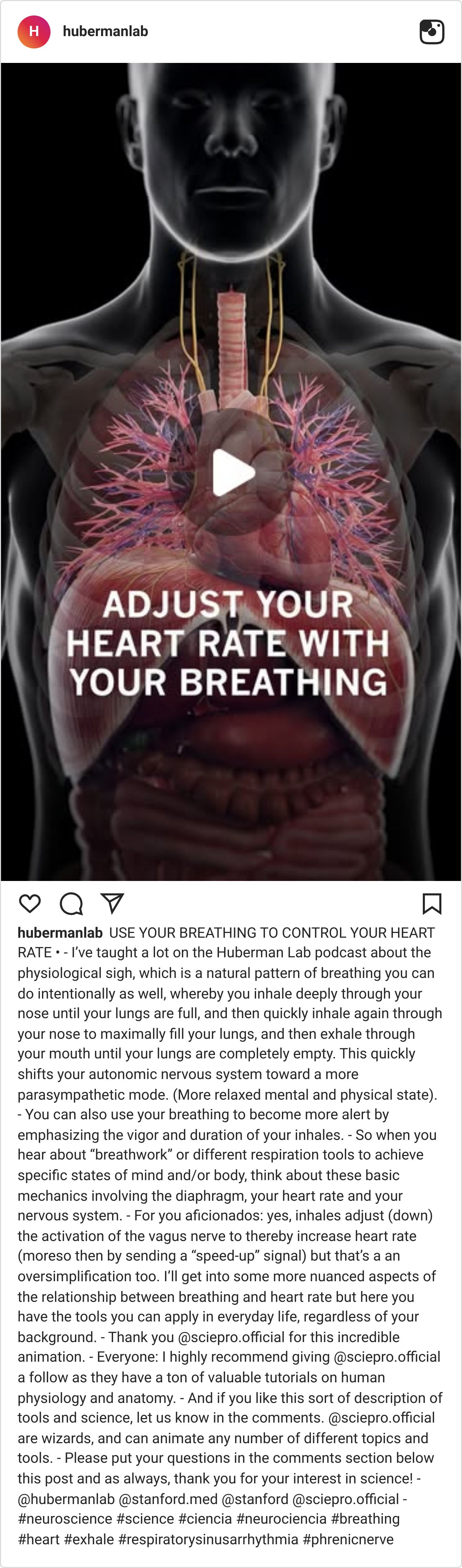
Five minutes a day, and it outperformed meditation on the outcomes closest to HRV. That is a small enough dose to actually keep. Here is Huberman himself walking through the sigh on Instagram, worth 60 seconds before you try it:
What this means for you
Two moves this week.
First, measure it. Without a number, HRV is a concept. With a number, it becomes feedback. Many of you already use a wearable, so take some time to see if HRV is a read on your device. If you don’t currently use a wearable, there are two devices we feel supremely confident recommending.
The Oura Ring 4 ($349 in silver or black, plus a $5.99 per month or $69.99 per year membership) is the strongest combined sleep and HRV picture for most subscribers. Nightly HRV, resting heart rate, respiratory rate, and sleep architecture all in one device. Battery lasts 4 to 7 days. The membership is required to see the trends, which is annoying, but the trend view is the whole point.
The Whoop 5.0 is the alternative if you want continuous strain scoring alongside recovery. Subscription starts at $17 per month on the 24-month plan ($399 upfront) and includes the device. 14-day battery. No display, which some prefer.
Whichever you pick, give it 14 days before you start reading it. Then look at the trend, not the day. One low morning tells you nothing. A quiet drift down over 2 weeks is the signal, and it usually points back to sleep, alcohol, or stress load.
Second, move it. Cyclic sighing is the fastest lever we have. Full inhale through the nose, second short sip on top, long slow exhale through the mouth. Five minutes. Best done in the first hour after waking, before the day takes control of you.
If you would rather be guided than count breaths in your head, there’s an app called Othership that runs sessions from 1 minute to 60. The sigh, box breathing, and Wim Hof-style patterns are all available to try.
If your baseline is low, three levers do the heavy lifting. Sleep, where every extra hour of quality moves next-morning HRV. Alcohol, where a single drink before bed drops HRV overnight for most people. And the 5-minute practice above. They stack. Two weeks of holding all three usually moves the number visibly.
What is next
The next issue looks at meditation itself. It does something real for a lot of people, and the trial data is more interesting than either the app category or the skeptics make it sound. We will walk through what meditation actually moves, where it lands strongest, and how it stacks with breathwork like the sigh above.
Longevity Daily / The Building Decades