| Longevity Daily |
Wed · May 27 |
|
|
The smartwatch on your wrist counted the hour you spent in the gym this morning. The body has been counting something else: the 23 hours either side of it, and the share of those hours you spent moving versus still.
Human biology was shaped for a day of light, near-continuous movement. Foraging populations average something like 14,000 to 18,000 steps a day at low intensity, broken by brief sits and the occasional sprint. The modern day delivers a different ratio. One hour of intense effort, if any. Then twelve to fourteen hours of sitting. The total minutes moved are not even close.
The contrarian point is not that the gym hour is wasted. It is that the watch shows you the smallest part of the picture and calls it the whole. The metric that better predicts how you age is total daily minutes moved, and total daily minutes still. You will not see either on the screen of any consumer wearable today.
|
|
|
Save this. Send it to one person who sits all day.
|
What The Research Actually Says
|
|
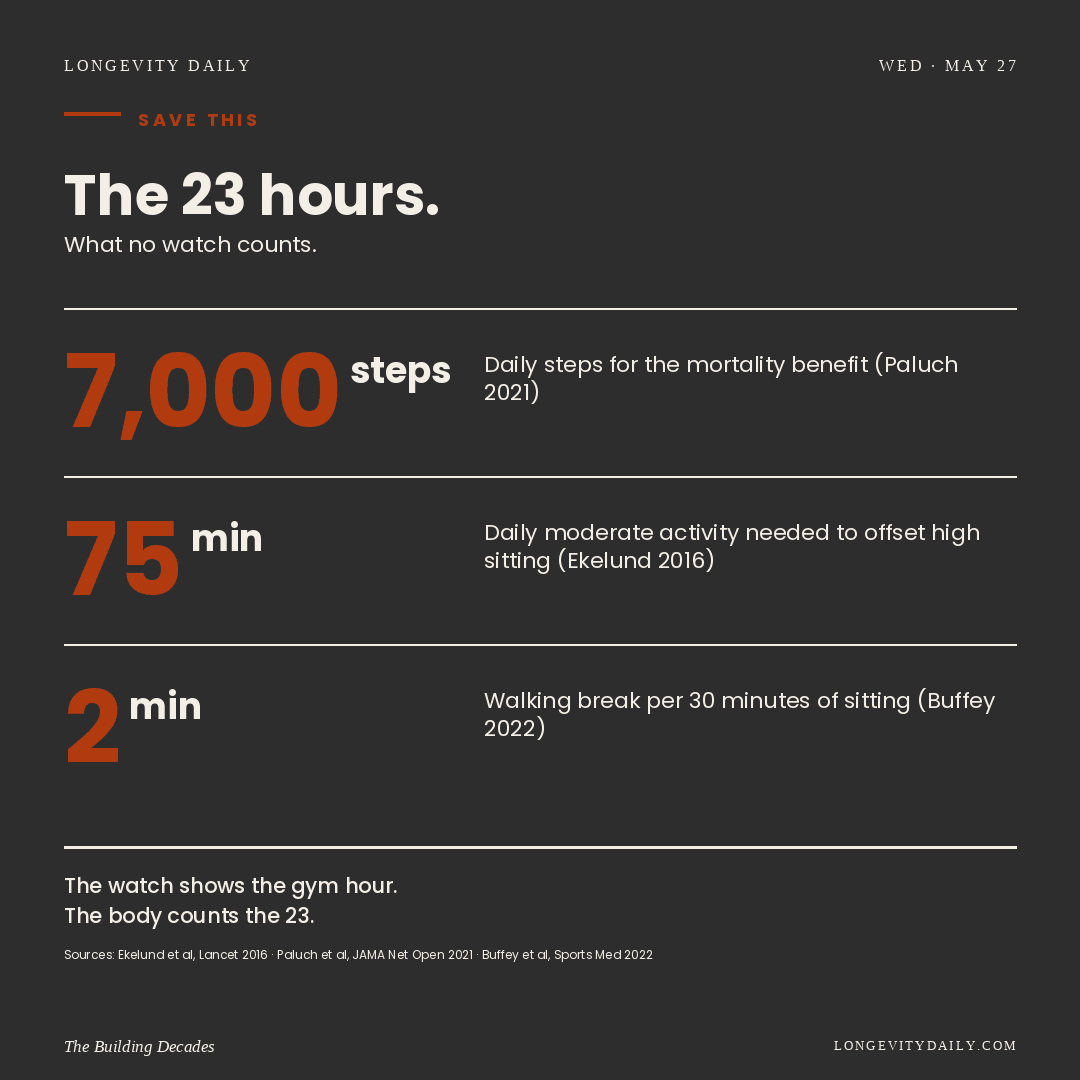
The single most important sitting paper to date is the Lancet 2016 harmonised meta-analysis (Ekelund et al), which pooled data on more than one million adults. It found that high sitting time was strongly associated with all-cause mortality, and that the only level of activity capable of fully offsetting it was 60 to 75 minutes of moderate-intensity movement every day. Not weekly. Daily. Most adults are not close. The honest read of that paper is that a forty-five-minute workout four days a week does not buy you out of the rest of your week's sitting. It helps. It does not erase.
So the daily total matters. How much? A 2021 study in JAMA Network Open, Paluch et al, tracked 2,110 middle-aged adults from the CARDIA cohort for almost eleven years and found that those who took 7,000 steps a day or more had a 50 to 70 percent lower risk of dying from any cause than those who took fewer. The benefit climbed up to about 10,000 steps and plateaued. The story is not the upper end. It is the floor. Most people miss the floor.
|
A forty-five-minute workout four days a week does not buy you out of the rest of your week's sitting.
|
The good news is that the in-day fix is smaller than people think. A 2022 systematic review and meta-analysis in Sports Medicine, Buffey et al, examined what happens when you interrupt prolonged sitting with short bouts of light walking. Two-to-five-minute walks every half hour cut the post-meal glucose spike by roughly 17 percent compared with continuous sitting. The break is not about minutes of cardio. It is about not letting the sit run unbroken.
That trio is the structure of an active life. Hit the daily step floor. Break up the long sits. The workout is fine, but it is the small part of the picture.
|
|
|
What The Watch Misses
|
|
You do not have a movement problem because you do not work out enough. You have a movement problem because the workout was the only movement, and you noticed.
The shift is from logging effort to accounting for time. How many of the day's waking hours did you spend on your feet, in some kind of motion. The watch will not tell you. A rough count will. Walk a phone call. Stand up between meetings. Park further. Take the stairs not as virtue but as default. Find the one repeated sit in your day, the long meeting, the evening on the couch, the desk-bound afternoon, and put a clock on it.
The body responds to total minutes moved, not minutes logged. You can begin the change between now and dinner.
|
| The Action |
|
Break the sit every thirty minutes. Two minutes on your feet, every half hour you spend seated. Walk every call you can take walking. Hit 7,000 steps before you log off today.
|
|
The watch shows the gym hour. The body counts the 23.
|
|
Friday Preview
|
|
Friday's edition: three things we learned this week. A movement-snack finding, a sixty-second balance test, and the kitchen swap that quietly lowers omega-6 without changing what you cook.
|
| Until Friday. |
| Longevity Daily · The Building Decades |
| Share this edition with someone who'd find it useful. |
|
|
|
|
Follow @longevitydaily_ · Subscribe
|