| Longevity Daily |
Fri · Jun 19 |
|
|
Three things we learned this week. All three are daily.
We covered the heat in Monday's issue and the case against recovery tools in Wednesday's. Three behavioural moves close the week. Walk. Breathe. Sweat. None of them costs anything. All three are in the cohort data already named.
|
|
|
Save this. Three behaviours, none of them in your closet.
|
1. Walk.
|
|
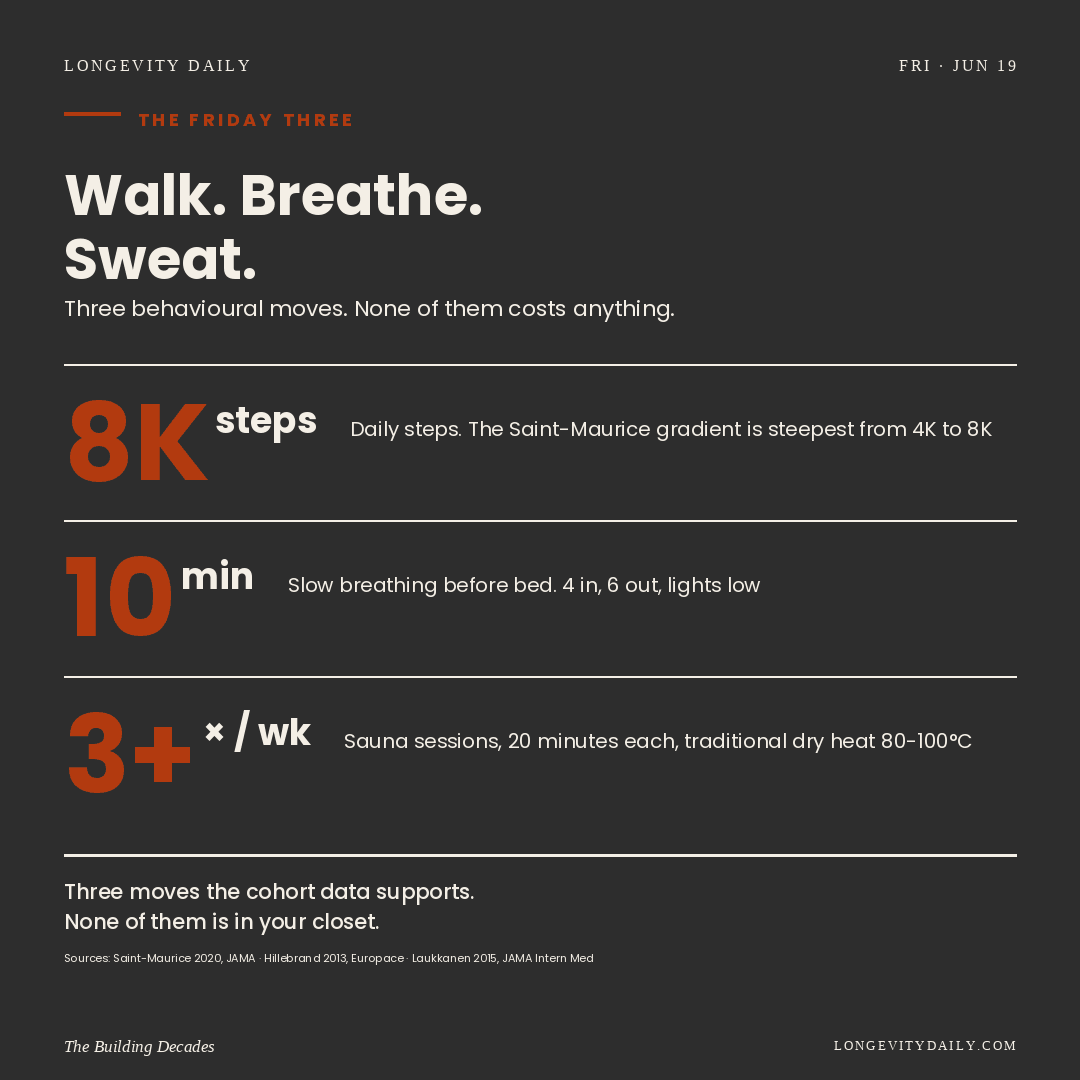
Most adults already sit at 7,000-plus steps on a normal week. That is a useful baseline. The Saint-Maurice et al cohort (JAMA 2020, NHANES, accelerometer-measured, followed for mortality through 2015) found the mortality gradient is steepest between 4,000 and 8,000 steps. Adults in the 8,000 band carried roughly 51 percent lower all-cause mortality than adults at 4,000. Pace did not change the result; volume did. If you are at 7,000, the next 1,000 is the highest-leverage move.
The simplest way to add it. A 10-minute walk after lunch or dinner gets most adults from 7,000 to 8,000 without a separate workout block. The phone counts steps. Apple Health and Google Fit both surface the daily total in one screen.
|
2. Breathe.
|
|
10 minutes of slow breathing before bed. 4 seconds in, 6 seconds out, in a quiet space with the lights low. The aim is to drop heart rate by 10 to 15 beats per minute before you lie down. Hillebrand et al, Europace 2013, the meta-analysis we cited Wednesday, links low HRV with a 32 to 45 percent higher first cardiovascular event risk. Slow exhalation is one of the few behaviours that moves HRV inside a single session.
If you want a guided version, Open is the strongest editorial pick. Evidence-led, paced for the 4-second-in 6-second-out range we named Wednesday, no flashy onboarding. The free tier covers the protocol we are pointing at.
|
|
|
3. Sweat.
|
|
Three sauna sessions this week, 20 minutes each, traditional dry heat at 80 to 100 degrees Celsius. Laukkanen et al, JAMA Intern Med 2015, the Finnish cohort we walked through on Monday. 4 to 7 sessions a week carried the cleanest mortality data; 2 to 3 was better than 1; 1 was better than nothing.
If you do not have access to a Finnish-style sauna, the Haghayegh hot-bath protocol from June 3 (40 to 43 degrees Celsius, 10 minutes, 1 to 2 hours before bed) is the closest substitute the published literature gives.
|
|
|
|
|
Your Weekend Action
|
|
One of the three is enough to start with. If the choice feels arbitrary, the highest-leverage first move depends on where you are. Below 6,000 steps a day, start with the walk. Above that, start with the slow-breathing block. The sauna is the third gear and slots in once the first two are sticking.
|
| The Action |
|
Pick one of the three. Hold it through next week. The walk if you are sedentary. The breathing block if you sleep poorly. The sauna if the first two are already locked. Three behavioural moves the cohort data supports, none of them in your closet.
|
|
|
Of the three behavioural moves, which is the one you have been writing around without acting on?
|
|
|
Further Reading
|
|
Two books that go deeper on the data behind items 2 and 3.
Breath, James Nestor. The book that put the slow-breathing literature on the mainstream radar. The chapters on nasal breathing and the 5.5-second exhalation pattern are the cleanest survey of the field for a general reader. Read once, refer to many times.
Why We Sleep, Matthew Walker. The sleep researcher's case for why the 10-minute downshift before bed matters more than most adults realise. Pairs naturally with item 2. The first three chapters are the highest-leverage hour you can spend on the sleep question this year.
|
| Until Monday. |
| Longevity Daily · The Building Decades |
| Share this edition with someone who'd find it useful. |
|
|
P.S. If you have not yet, the Healthspan Score is the five-minute assessment that surfaces which of the three behavioural moves is most likely the next lever for your number. Free, no blood draw.
|
|
Sources
Saint-Maurice et al, JAMA 2020 · Hillebrand et al, Europace 2013 · Laukkanen et al, JAMA Intern Med 2015
|
|
Follow @longevitydaily_ · Subscribe
|