
FRIDAY'S MOST CLICKED
Cronometer, the free food log
It counts more than calories. Log one ordinary day and it shows your fibre, which is about to matter for your cholesterol too.
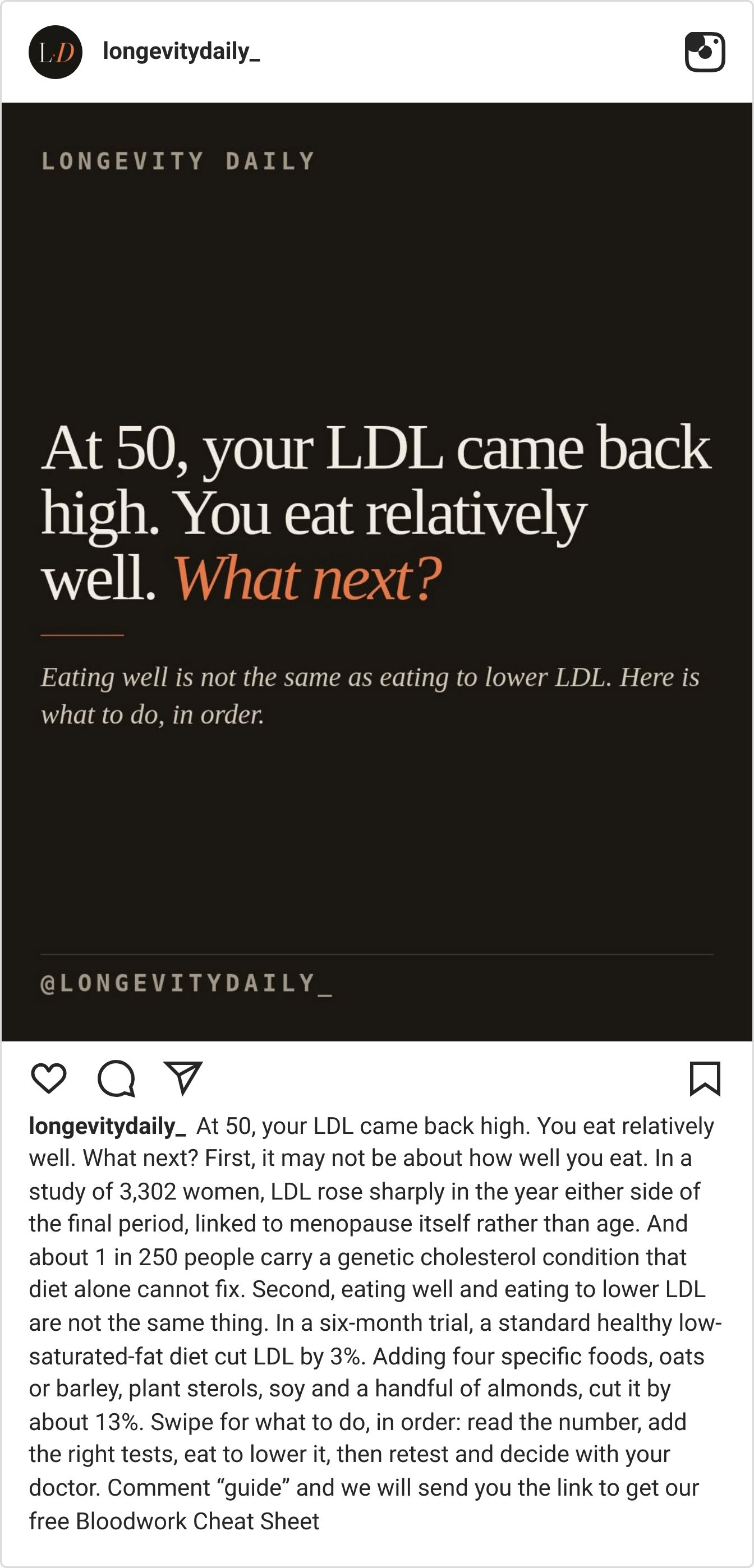
Your lab report came back. Most of it sits in the normal range. One line is flagged: LDL cholesterol, high.
You eat reasonably well. You walk most days. This was not the result you expected, and the advice that came with it was probably one sentence about saturated fat.
Eating well and eating to lower LDL are not the same thing.
Most people never get the cholesterol conversation explained properly, so this issue starts there. Then it covers why LDL often rises in midlife whatever you eat, when a statin makes sense, and the way of eating built specifically to bring LDL down, known as the Portfolio approach.

The Cholesterol Conversation, Simply
Cholesterol does not float freely in your blood. It travels inside particles, a bit like cargo inside trucks.
LDL cholesterol, the number on most reports, measures the cargo: how much cholesterol those trucks are carrying. The harm comes from the trucks themselves. Each one that slips into an artery wall can leave cholesterol behind, and over decades that builds into plaque.
ApoB counts the trucks. Every one of these particles carries a single ApoB protein, so the test is a direct headcount.
We have written about ApoB a lot, and you will keep hearing about it here. It is probably the marker most GPs miss that has the biggest bearing on your risk. In the Framingham Offspring Study of more than 3,100 men and women, ApoB was linked to heart disease in both sexes, while LDL alone was linked only in women. The 2026 US cholesterol guideline now says ApoB can reveal leftover risk even after LDL reaches a healthy range. If you have never had it measured, here are the three tests to ask for by name.
The Evidence
Three findings explain most high LDL results in men and women.
1. It may not be your diet. Age and hormones move LDL, on different timelines for men and women. In the same Framingham study, men carried higher average LDL and ApoB than women, and both rose with age. For women the jump tends to come at menopause: in the SWAN study of 1,054 women, LDL and ApoB rose sharply in the year either side of the final period, a change the researchers tied to menopause itself rather than to age.
2. It can be inherited. About 1 in 250-300 people carry familial hypercholesterolaemia, a genetic condition that keeps LDL high from birth, according to a review of 11 million people. Food helps, but it cannot fix it. An LDL of 190 mg/dL (4.9 mmol/L) or higher, or a parent or sibling with heart disease at a young age, is the signal to ask about it.
3. Four specific foods move LDL far more than healthy eating did. In a six-month trial of 351 adults with high cholesterol, a standard healthy low-saturated-fat diet cut LDL by 3%. However, adding four foods, oats or barley, plant sterols, soy and a handful of almonds, cut it by about 13%. That’s 4x higher impact from adding foods, compared with removing foods. In an earlier, stricter trial where every meal was supplied for a month, the same foods cut LDL by 29%, close to 31% from a low-dose statin.
Soluble fibre binds cholesterol in the gut so you pass it out, and plant sterols block some of it from being absorbed in the first place.
Eating well and eating to lower LDL are not the same thing. The real insight is eating those specific foods every day.
When A Statin Makes Sense
For most people food comes first, and for some a statin comes next. The 2026 guideline bases the decision on your 10-year risk of a heart attack or stroke, worked out with the free PREVENT calculator from your age, sex, blood pressure, cholesterol and a few other numbers.
Under 3%. Food and movement first. A statin becomes reasonable if LDL stays between 160 and 189 mg/dL (4.1 to 4.9 mmol/L), or your 30-year risk is high.
3% to 5%. A judgement call. Risk enhancers tip it: heart disease in a parent or sibling before 55 for men or 65 for women, raised Lp(a), and for women, menopause before 45, pre-eclampsia or gestational diabetes.
5% to 10%. A statin is generally recommended.
Over 10%, or LDL of 190 mg/dL (4.9 mmol/L) and up. A statin is recommended, with food working alongside it.
A 4% risk means 4 in 100 people like you having a heart attack or stroke in the next 10 years. We made the case against reflex prescribing in July, and the guideline now asks for the same thing: a decision made with you, based on your actual risk.
Where Red Yeast Rice Fits
Red yeast rice has a long history in Traditional Chinese Medicine, and modern trials support it. A review of 15 trials found it lowered LDL by about 28 mg/dL (0.7 mmol/L) compared with control, roughly as much as the statins it was tested against.
Its active compound, monacolin K, is chemically identical to lovastatin, the statin. So it carries the same possible muscle and liver side effects, in a dose that varies from bottle to bottle. One test of US products found anywhere from 0.1 mg to 10 mg of monacolin K per capsule. Some products also carry citrinin, a fermentation by-product that is toxic to the kidneys, which is why Europe tightened its limit in 2020.
If you use it, choose a product that states its monacolin content and is tested for citrinin, never take it alongside a statin, and treat it like the medication it is. That is worth discussing with a clinician who knows you.
What This Means For You
It's as simple as this.
Read the full panel. Ask for ApoB, and for Lp(a) once in your life. The 2026 guideline now recommends Lp(a) for every adult.
Eat to lower LDL, every day. Soluble fibre first: oats, barley, beans and psyllium. Then a handful of nuts, about 45 g, soy foods such as tofu, edamame or soy milk, and plant sterols from fortified spreads or yoghurt drinks.
Cut back on the main LDL raisers. Minimise butter, ghee, coconut oil and deli meats like ham and bacon. Choose white meat and seafood over red meat.
Retest in 12 weeks. Then run your numbers through the PREVENT calculator before you decide on medication.
This is your plan now. Notice how a fibre-led breakfast holds you through the morning, and let the retest show you what changed.
One honest caveat. People absorb different amounts of cholesterol from food, so the same plan can bring a big drop for one person and a modest one for the next, as Cleveland Clinic's cardiologists point out. And no way of eating fixes an inherited LDL problem.
ApoB and Lp(a) without a referral: Ulta Lab Tests or Function Health in the US, Medichecks in the UK, and the i-screen advanced lipid test in Australia. Plant sterol spreads and yoghurt drinks sit in the dairy aisle in all three countries. Psyllium is sold as Metamucil in the US and Australia, and as Fybogel in the UK.
FROM OUR INSTAGRAM
Wednesday Preview
Some people with high LDL have clean arteries, and some with normal LDL do not. On Wednesday: the quick, low-dose heart scan the guideline now uses for men from 40 and women from 45, and how it can settle the statin question.
Until Wednesday.
Longevity Daily / The Building Decades
P.S. If your LDL is 190 mg/dL (4.9 mmol/L) or higher, skip the 12-week wait and ask about genetics and medication now. For everyone else, the best first move is still the Portfolio approach.