WEDNESDAY'S MOST CLICKED TOOL
Cronometer, the free food tracker
After our walk issue, the most clicked link on Wednesday was Cronometer. It is also the easiest way to count today's two numbers: fibre in grams, and the number of different plants.
Your gut bacteria eat what you eat, and they do best on three things.
Monday was about when to stop eating. Wednesday was about when to start eating. Today is about what to eat in between.
Your gut bacteria break down the parts of food you cannot digest, and turn them into compounds your body uses. Here are the three things they do best on, and one number worth counting each week.
1. Fibre
Fibre is the part of a plant your body cannot digest. Your gut bacteria can, and it is their main source of food. A Lancet analysis covering 135 million person-years found people eating the most fibre had 15% to 30% lower rates of early death, heart disease, stroke, type 2 diabetes and bowel cancer than those eating the least. The benefit was strongest at 25g to 29g a day. Beans, lentils, oats and whole grains are the quickest way to get there.
2. Fermented food
In a Stanford trial of 36 adults, eating plenty of fermented food for 10 weeks steadily increased the variety of gut bacteria and lowered 19 markers of inflammation, including IL-6. A high-fibre diet in the same trial did not increase variety. Yogurt, kefir, sauerkraut and kimchi have been part of traditional diets for centuries, and the research is starting to show why.
3. Variety
The American Gut Project collected samples from more than 10,000 people. Those who ate more than 30 different plants a week had a wider range of gut bacteria than those who ate 10 or fewer, whether they were vegan or ate meat. Nuts, seeds, herbs and beans all count, so the number adds up faster than you might think.
Putting the week together: close the kitchen early, start the day with protein, and fill the hours in between with fibre, fermented food and lots of different plants.

Your Weekend Action
It's as simple as this.
Start a plant count on Saturday. Every different plant counts once: vegetables, fruit, beans, grains, nuts, seeds, herbs.
Add one fermented food a day. A spoon of sauerkraut, a cup of kefir or a bowl of plain yogurt.
Add beans or lentils to one meal you already eat. A tin stirred into a soup, salad or curry is an easy way to add fibre.
By next Friday, see how close to 30 you got, and notice how your digestion and energy feel.
Kefir and plain yogurt are in most supermarkets in the US, UK and Australia. Look for "live cultures" on the label, and buy sauerkraut and kimchi from the fridge, since shelf-stable jars are usually heat-treated, so the good bacteria is gone. To track the week, log a day in Cronometer or use the circles on the image above.
FROM OUR INSTAGRAM
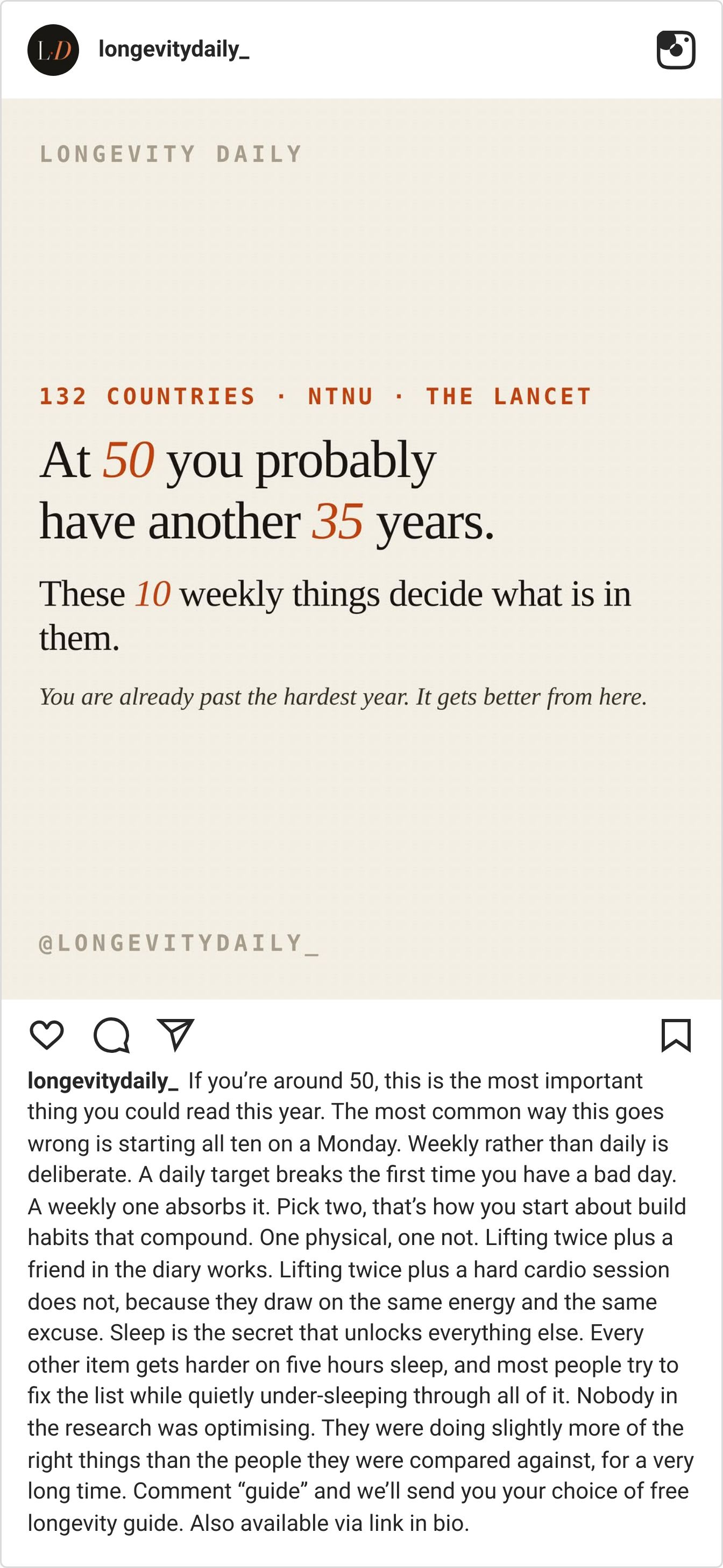
The habits that compound, two at a time
Our most saved post this month, saved by over 35,000 people.
The Week in Longevity
Three studies making news this fortnight. Thirty seconds each.
01 · GUT
In 62 people, both kinds of coffee were linked to lower stress and low mood once reintroduced, and decaf to better learning and memory. Small, and sponsored by a coffee industry institute. Go deeper →
02 · HEART
In 15 patients with hard-to-treat cholesterol, the highest dose cut LDL by 52.5% and triglycerides by 47.8% at 12 months. An early trial, funded by the company developing it. Go deeper →
03 · AGEING
Across more than 164,000 UK and US adults, faster biological ageing was linked to a 15% higher risk of solid cancers before 55. The study shows a link, but cannot prove one causes the other. Go deeper →
Monday Preview
Next week we look at what all this food means for your heart. On Monday: what to do when your cholesterol comes back high.
Until Monday.
Longevity Daily / The Building Decades