MONDAY'S MOST CLICKED
The 10-minute walk after dinner
The most clicked link in Monday's issue was our case for the post-meal walk. It pairs with everything below: close the kitchen early, walk after dinner, open it with protein.
Black coffee at 7. No food until noon. This is what most people call intermittent fasting.
Fasting is not one thing. How long you go, and when, decides what it does.
Fasting is one of the oldest health practices there is, and one of the most oversold. A 12-hour overnight fast, a 16-hour window and a 3-day fast do different things in the body, and the research behind each is very different.
The short version builds on Monday: finish eating earlier and start your day with protein.

What Happens When You Stop Eating
Your body runs on a simple fuel schedule.
The first few hours. You are running on the meal you just ate. Insulin is up and the body is storing fuel.
Around 12 hours. The liver runs low on stored sugar and the body switches to burning fat, turning some of it into ketones. Researchers call this the metabolic switch. A 2019 review in NEJM linked it, mostly in animal studies and early human trials, to better blood sugar control, lower blood pressure and greater resistance to stress.
Beyond a day. Ketones keep climbing, and in animals, cells turn up autophagy: their recycling system for worn-out proteins and damaged parts. The work behind it won the 2016 Nobel Prize.
An early dinner and a normal breakfast already get you past the first switch.
Giving your digestive system a daily break is good for longevity. 12 hours is the minimum. 14 to 16 hours is the goal.
The Four Ways To Fast
1. The overnight fast. The one you are probably close to already. Stop eating by 7:30pm, eat breakfast at 7:30am, and you have fasted 12 hours. It crosses the metabolic switch, keeps every meal and needs no app. It is the base the other three are built on.
It is also easy to remember: 6pm to 6am, or 7pm to 7am.
2. Time-restricted eating, usually 16:8. The popular one, where timing matters more than length. In the TREAT trial, 116 adults ate only between noon and 8pm for 12 weeks. They lost no more weight than a group eating 3 meals, and lost more muscle from their arms and legs. Move the same 16-hour fast to the other end of the day and the picture changes. In a 14-week trial of 90 adults, 80% of them women, eating between 7am and 3pm led to 2.3 kg more weight loss than eating across 12 hours or more, and diastolic blood pressure fell 5 points against 1. In a small trial of 8 men with prediabetes, eating within 6 hours, finished by 3pm, improved insulin sensitivity and blood pressure in 5 weeks without any weight loss.
For weight alone, the bigger picture is modest. A 2026 Cochrane review of 22 trials and nearly 2,000 adults found intermittent fasting did not produce meaningfully more weight loss than standard diet advice.
3. The 5:2 and alternate-day fasting. Harder days, similar results. Around 500 calories on fast days, either 2 days a week or every second day. A review of the fasting trials found 3% to 8% weight loss over 8 to 12 weeks, on par with ordinary calorie cutting, with about 75% of it fat and 25% lean tissue.
4. Extended fasts and the fasting-mimicking diet. This is where autophagy actually lives. Water-only fasts of 24 to 72 hours or more, or a 5-day fasting-mimicking diet of low-calorie soups and bars designed to copy a fast while you still eat. Autophagy switches on strongly in these longer, deeper fasts in animals, which is why the claims attached to a 16-hour window overreach. In people it is hard to measure, and the human data is early. In a trial of 100 adults, 3 monthly 5-day cycles lowered weight, blood pressure and IGF-1, a growth signal linked to ageing and cancer risk. A 2024 analysis of two trials estimated biological age fell 2.5 years on average, and a 2025 trial suggested the diet may raise autophagy in human blood cells. Worth knowing: most of this comes from one lab, and the 2025 trial was sponsored by L-Nutra, the company that sells the diet.
Promising, early, and not something to do on your own. Water fasts beyond a day or two are worth discussing with a clinician who knows you first, especially if you take any medication.
Fasting In The Second Half
In the second half of life, the risk to watch with fasting is muscle, not hormones.
When women before and after menopause ate in a 4 to 6 hour window for 8 weeks, estrogen and progesterone did not change in the postmenopausal group. DHEA fell about 14%, but stayed within the normal range. Women in perimenopause were not studied.
Why DHEA matters: the body uses it to make estrogen and testosterone, and levels already fall with age. Low levels have been linked with low energy, flat mood, lower libido and a dimmer sense of wellbeing. A 14% dip over 8 weeks, still in range, is small. If you already feel flat, it is one more reason to keep any fast gentle.
Muscle is the bigger concern. It is already harder to hold on to through and after menopause, the noon-to-8pm group in TREAT lost more of it, and fasting guidance cautions people over 70 for exactly this reason. Any fast that squeezes out a protein meal works against you.
Who Should Skip It
Fasting is not for everyone. The clinical guidance from one of the leading fasting research teams says it is not for you if you:
are pregnant or breastfeeding
have a history of an eating disorder
are underweight, with a BMI below 18.5
The same guidance cautions people over 70, because nobody yet knows what fasting does to age-related muscle loss. If you have diabetes, or take medication that has to go with food, it is worth discussing with a clinician who knows you before you start, since doses may need adjusting.
The Bottom Line
It's as simple as this.
Start with the overnight fast. Keep Monday's kitchen close time, 3 hours before bed, and leave about 12 hours to breakfast.
Aim to start your day with about 30g of protein. In a feeding study, around 30g at each of 3 meals built more muscle over 24 hours than the same protein loaded mostly into dinner.
Want to try 16 hours? Take it from the evening, not breakfast. An earlier dinner lengthens the fast without losing the meal that carries your protein.
Curious about longer fasts? Treat them as an occasional experiment, planned with a clinician who knows you, not a weekly habit.
Try the first three for 2 weeks. Notice how steady your energy feels at 11am, and measure your waist at the start and the end.
Eggs, Greek yogurt and cottage cheese cover most mornings. If you need a shortcut, Thorne Whey Protein Isolate adds 21g a scoop. To see where your protein lands across the day, log one ordinary day in Cronometer, which is free.
FROM OUR INSTAGRAM
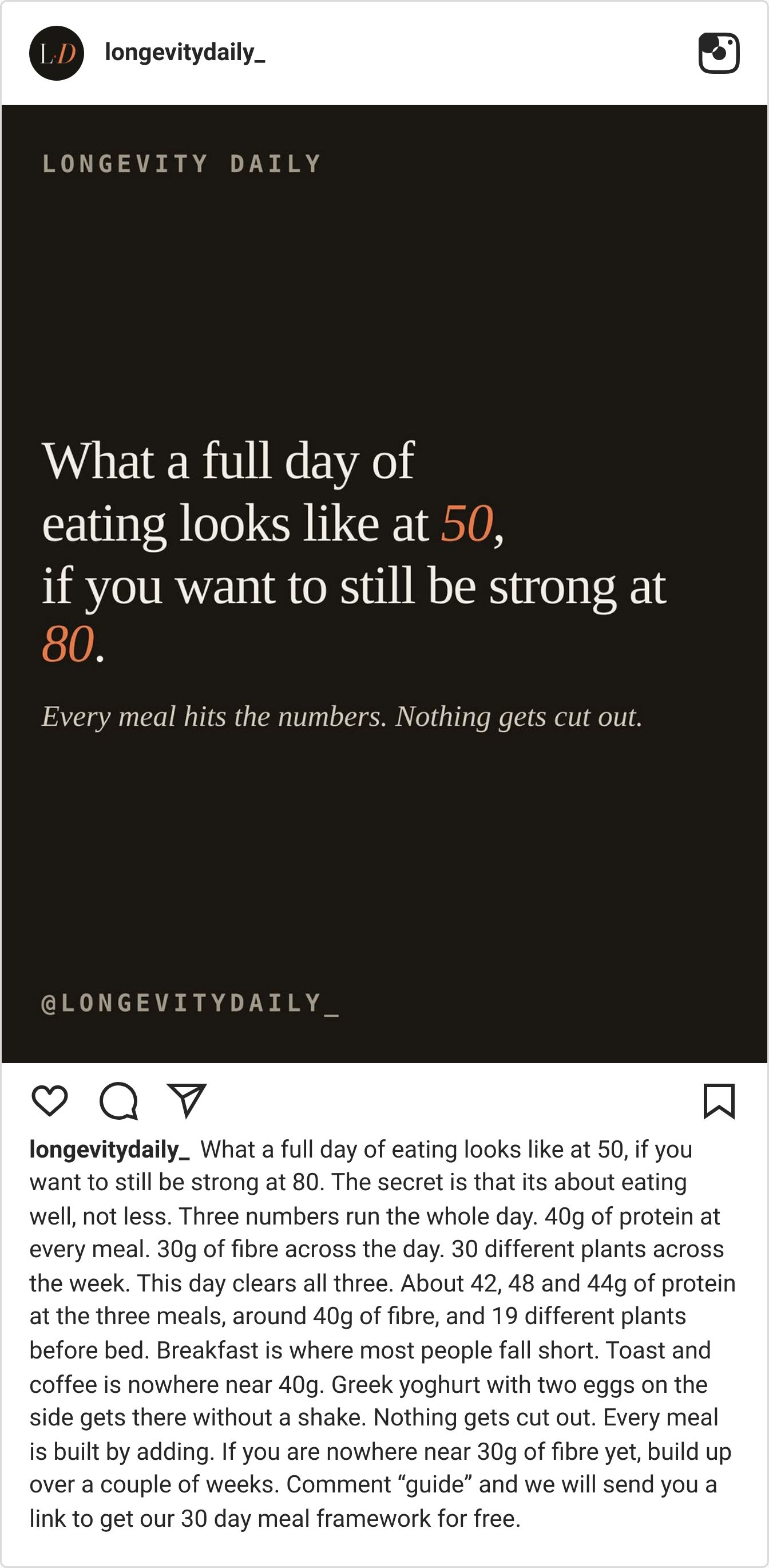
A full day of eating, built by adding
Now saved more than 6,400 times. 40 g of protein at every meal, 30 g of fibre across the day and 30 different plants across the week. It is today's protein move, laid out as a whole day.
Worth Your Time
Friday Preview
Monday set a time to close the kitchen. Today guides you on when to open it. Friday is about what you feed in between, and the gut bacteria that do best on it, starting with the three foods they like most.
Until Friday.
Longevity Daily / The Building Decades