
MONDAY'S MOST CLICKED
The Portfolio approach to lowering LDL
Cleveland Clinic's short guide to the four foods that moved LDL in the trials. If your number came back high, start here.
More people are paying for a coronary calcium scan. It is a quick CT that measures the calcium in the arteries around your heart, and many people book one out of curiosity.
Two studies published in August, in JAMA and the Journal of the American College of Cardiology, looked at who the scan helps most. They also found that a score of zero does not always mean you are safe.
A calcium scan is worth considering if your LDL or ApoB is still high after changing how you eat and live, or if you have been offered a statin and want to see what is actually in your arteries.
On Monday we covered how to read a high LDL result and work out your 10-year risk with the free PREVENT calculator. This issue covers the next step: what a calcium score tells you, who it helps, and what a score of zero means for you.

What The Research Actually Says
Many people assume everyone should get scanned, and that a zero means all clear. The research is more specific than that.
1. It helps most when your risk is in the middle. The two August studies followed about 6,000 people for 10 years. For most of them, the scan added little to the PREVENT score. For people with a 10-year risk of roughly 3% to 10%, it clearly showed who went on to have a heart attack or stroke.
2. It shows who a statin will help. In a study of 13,644 people followed for about 9 years:
Score of zero: statins made no measurable difference.
Score of 1 to 100: for every 100 people who took a statin, 1 heart attack or stroke was prevented.
Score above 100: for every 12 people who took a statin, 1 was prevented.
The higher your score, the more likely a statin is to help you personally.
3. Seeing your own plaque helps you stick with treatment. In the CorCal trial of 5,772 adults (51% women), half had their statin decision guided by a scan and half by a risk calculator. Heart attacks, strokes and deaths were the same in both groups. But 62% of the scan group stayed on their statin, against 23% of the calculator group.
It works the way a skin check does. Being told you have sun damage is easy to ignore. Having a dermatologist cut a cancerous spot off your arm makes sunscreen feel a lot less optional.
The trial was funded by a hospital system and a private foundation, not a drug company.
A zero has limits too. Some people with a zero score and a 10-year risk of 5% or more still had heart attacks and strokes.
The 2026 US guideline also uses the score to decide how hard to treat, so a high result can mean lower LDL targets, not just a yes or no on a statin.
The Bottom Line
Here is the whole thing.
Run your PREVENT score first. The PREVENT calculator is a free online tool from the American Heart Association. You enter your age, sex, blood pressure, cholesterol and a few other numbers, and it estimates your chance of a heart attack or stroke in the next 10 years. If that comes back under 3% and your LDL is below 160 mg/dL (4.1 mmol/L), a scan is unlikely to change the advice.
Between 3% and 10%, consider the scan. The 2026 US guideline backs it for men from 40 and women from 45 when the statin decision is unclear.
Read the result. A zero makes it reasonable to hold off a statin and rescan in 3 to 7 years, unless you smoke, have diabetes, inherited high cholesterol or a strong family history. Any score above zero means plaque is there, and the guideline recommends a statin. The higher the score, the lower your LDL target: under 100 mg/dL (2.6 mmol/L) for a score of 1 to 99, and under 70 mg/dL (1.8 mmol/L) from 100.
Over 10%, or LDL of 190 mg/dL (4.9 mmol/L) and up? The guideline already recommends a statin. A scan can still show how much plaque you have, which helps set how hard to treat, and seeing it makes treatment easier to stick with.
Work out which group you are in, so you know what a scan can tell you.
One honest caveat. The scan sees calcified plaque only. Softer, newer plaque does not show up, which is why a zero in someone at higher risk does not rule a problem out.
In the US a scan typically costs $100 to $400 and is often not covered by insurance. In the UK and Australia, prices and referral rules vary, so ask your GP or search for coronary calcium scoring near you.
FROM OUR INSTAGRAM
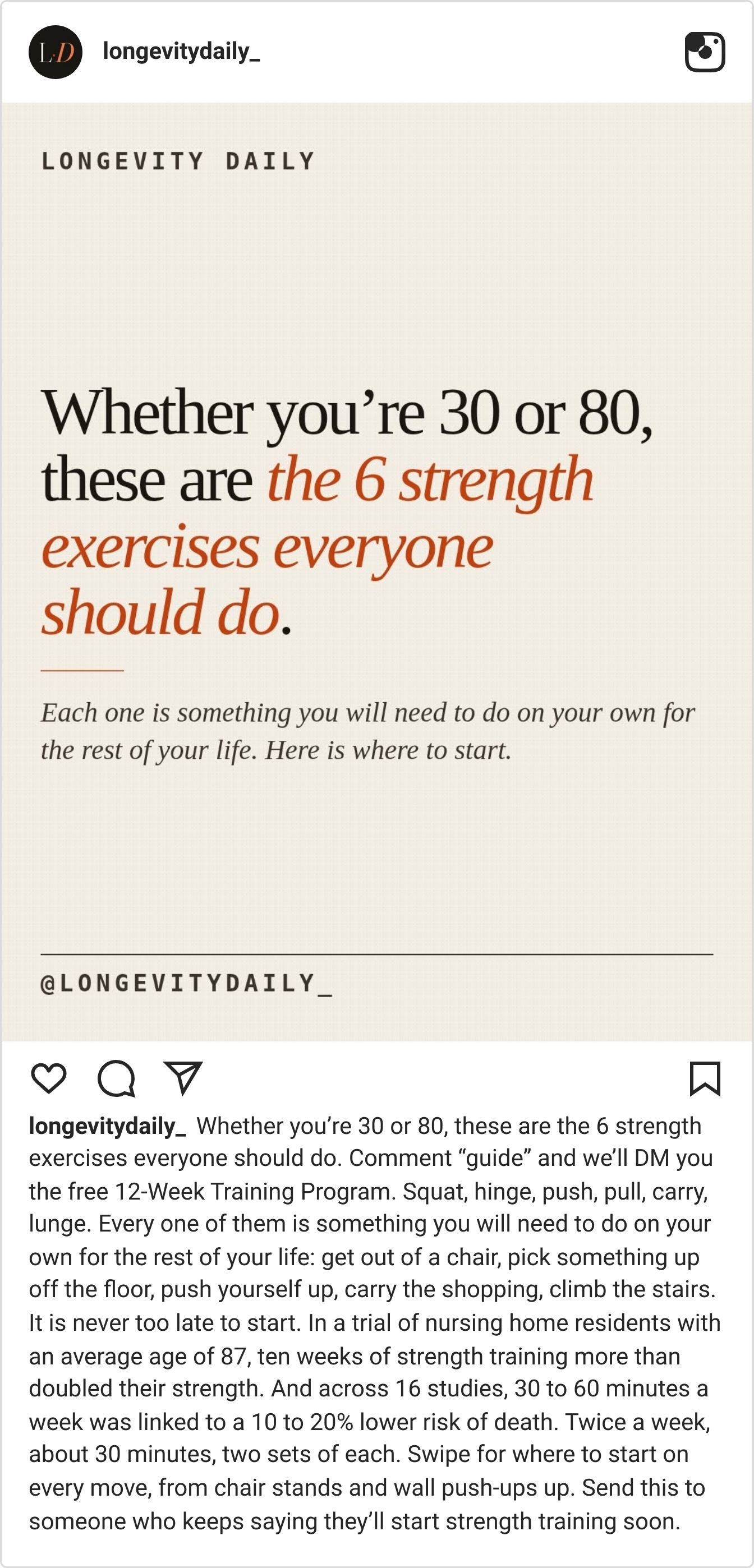
The 6 strength exercises everyone should do
Squat, hinge, push, pull, carry and lunge, with where to start on each. Whatever your calcium score, regular training is part of looking after your heart.
Worth Your Time
Have you had a calcium score, and did it change what you did next? Hit reply and tell us. We read every one.
Friday Preview
A scan shows what is already in your arteries. On Friday we finish heart week with two things it cannot show: the family history question worth asking this weekend, and the heart attack signs that look different in women and men.
Until Friday.
Longevity Daily / The Building Decades
P.S. Had a chest CT recently for something else? A Circulation study in July found calcium seen on those scans predicted heart events about as well as a dedicated scan. Ask whoever ordered it whether the report mentions coronary calcium, then put it next to your PREVENT score.