
It takes roughly four to six oranges to make a single glass of orange juice. You would never eat that many in one sitting, and if you did, the fibre in the fruit would slow the sugar on its way to your liver. The juicer removes the fibre.
What lands in your bloodstream is closer to a soft drink than to a piece of fruit.
Cold-pressed does not change that. The extraction method affects the polyphenols marginally and the fibre not at all. Fresh does not change it either. The relevant chemistry is what happens once the fibre matrix is gone.
When you drink juice, the fructose and glucose hit your liver all at once instead of slowly over time. That's the difference between eating an orange and drinking a glass of orange juice.
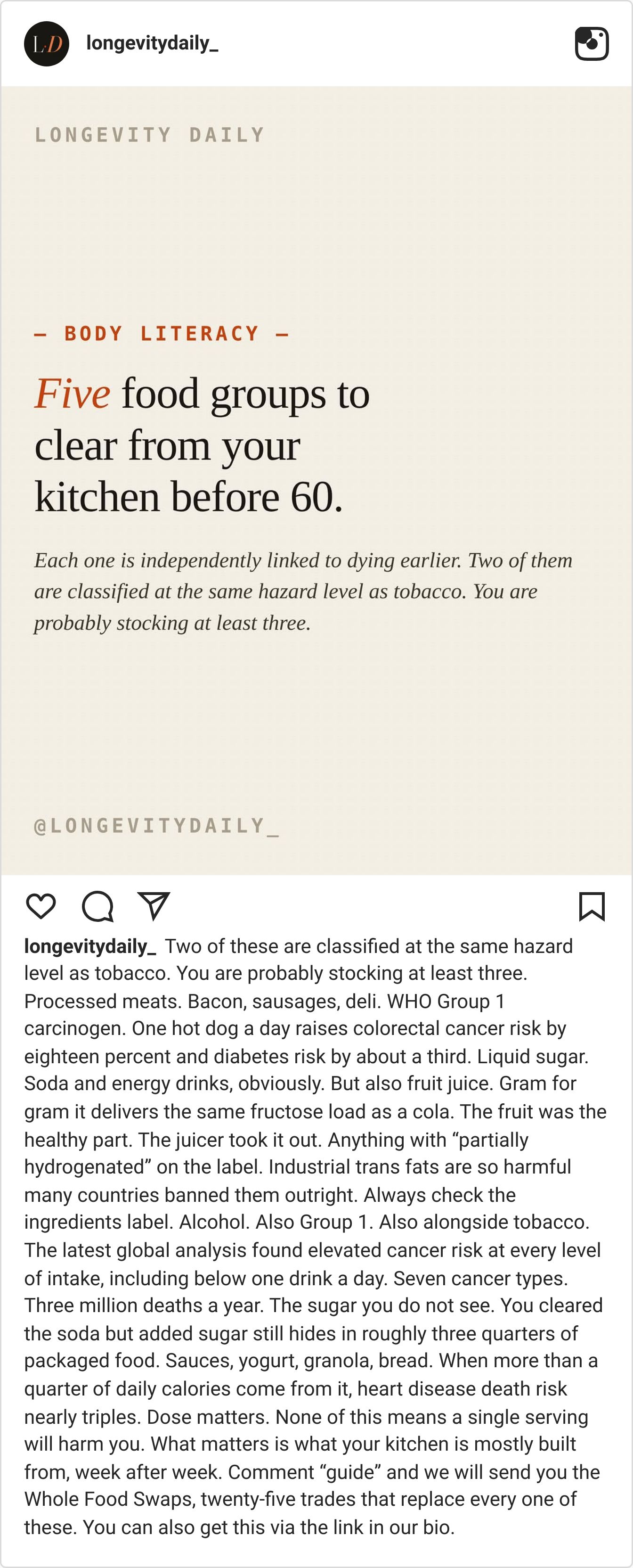
The carousel we ran on Instagram over the weekend named liquid sugar as one of five food groups to clear from a kitchen. Alcohol was Monday's deep dive. Juice is the second item on that list, and probably the one that hits closest to home, because most kitchens still stock it as a health item.
What the research actually says
Here is the finding that should make you rethink the juice aisle. Bazzano and colleagues, in the BMJ 2013, followed 187,000 nurses and health professionals for close to two decades and asked, at repeated intervals, what they ate. The people who ate the most whole fruit had the lowest rates of type 2 diabetes. The people who drank the most fruit juice were among the highest. Same fruit, same person, different delivery.
The mechanism is fructose. When fruit is whole, the fibre works like a speed bump. Fructose reaches your liver gradually, glucose is used first, and most of the rest gets tucked away quietly. When the fibre is gone, so is the speed bump. Fructose arrives all at once, and past a certain volume your liver has one main option. It converts the excess directly into liver fat. Do that at breakfast, day after day, and you have a real path to fatty liver disease. Softic and colleagues walked the pathway in Digestive Diseases and Sciences in 2016.
About one in four adults globally now carry some degree of fatty liver disease, per the 2016 Younossi meta-analysis in Hepatology. Most of them do not know. Fatty liver rarely announces itself early.
The direct sugar comparison lands where you would expect it to. A 240-millilitre glass of 100% orange juice has about 20 grams of sugar. The same glass of Coca-Cola has about 25. Coke wins the sugar race, and its fructose share is higher because high-fructose corn syrup is 55% fructose. But the load delivered to your liver without any fibre to slow it down is in the same ballpark. In the labs that have measured how blood sugar and insulin respond to each drink, the orange juice spikes look a lot like the soft drink spikes.
The fruit was the healthy part. The juicer took it out.

The card shows 4-6 oranges per glass, ~20g sugar per 240ml glass, and one-in-four adults with NAFLD.
The bottom line
None of this means a glass of juice at Sunday brunch is going to give you fatty liver. Dose matters. What matters is what the kitchen is mostly built from, week after week. Three concrete swaps that most Longevity Daily readers can make without really noticing.
For your kids' breakfast, offer the whole fruit with a glass of water instead of a glass of juice. Same vitamin C, no rapid fructose hit, and the fibre keeps them full for longer. For the post-workout or thirst quencher, water plus a piece of fruit outperforms juice on hydration and on glycogen replenishment in most of the sports nutrition literature. Athletes still reach for the OJ because tradition is heavy, but the evidence is not with them.
For your own morning, start before the coffee and before the food. Half a lemon squeezed into a mug of warm water, drunk on an empty stomach, is one of the simplest naturopathic-first habits you can install. Overnight your body has been mildly dehydrated for eight hours. The warm water rehydrates, the lemon adds a small hit of vitamin C, and the mild acidity gently wakes up the digestive tract before you ask it to process caffeine and food. Coffee and breakfast land differently on a body that has already had water.

Recommendation of the week: Thrive Market. Same brand as Monday, different aisle. If juice is coming out of your kitchen this month, this is where we would tell you to shop for the replacements. Their beverage section leans low-sugar and no-added-sugar, and their produce runs whole fruit rather than the juiced version of it.
The store-wide policy is the reason we keep pointing here. Partially hydrogenated oils, high-fructose corn syrup, and artificial dyes are excluded on principle.
Friday preview
Processed meats. Trans fats. Hidden sugar. The three shelves we have not covered from the carousel yet, and the twenty-five whole-food swaps that replace every one of the five items. Friday.
Reply with a commitment to trying warm water and lemon first thing in the morning for a week.
Until Friday.
Longevity Daily · The Building Decades
Share this edition with someone you love.
P.S. The Whole Food Swaps guide covers the specific swaps for every liquid-sugar habit above. Six guides, 139 pages, every claim cited. join.longevitydaily.com/guides.