
The healthy-red-wine story rested on a molecule called resveratrol, found in the skin of red grapes. A 2006 mouse study by David Sinclair's lab suggested it might slow aging, and "a glass of red with dinner" quietly became health advice. To reach even the lowest resveratrol dose that has ever shown any benefit in a human trial, you would have to drink about your own body weight in red wine every day. Let that sink in.
For decades the story held that moderation was fine. One glass of wine with dinner was heart-protective, and the real danger only started at three or four a night. In January 2023 the World Health Organization moved to a different position, and the wording is worth reading out loud. No level of alcohol consumption is safe for our health.
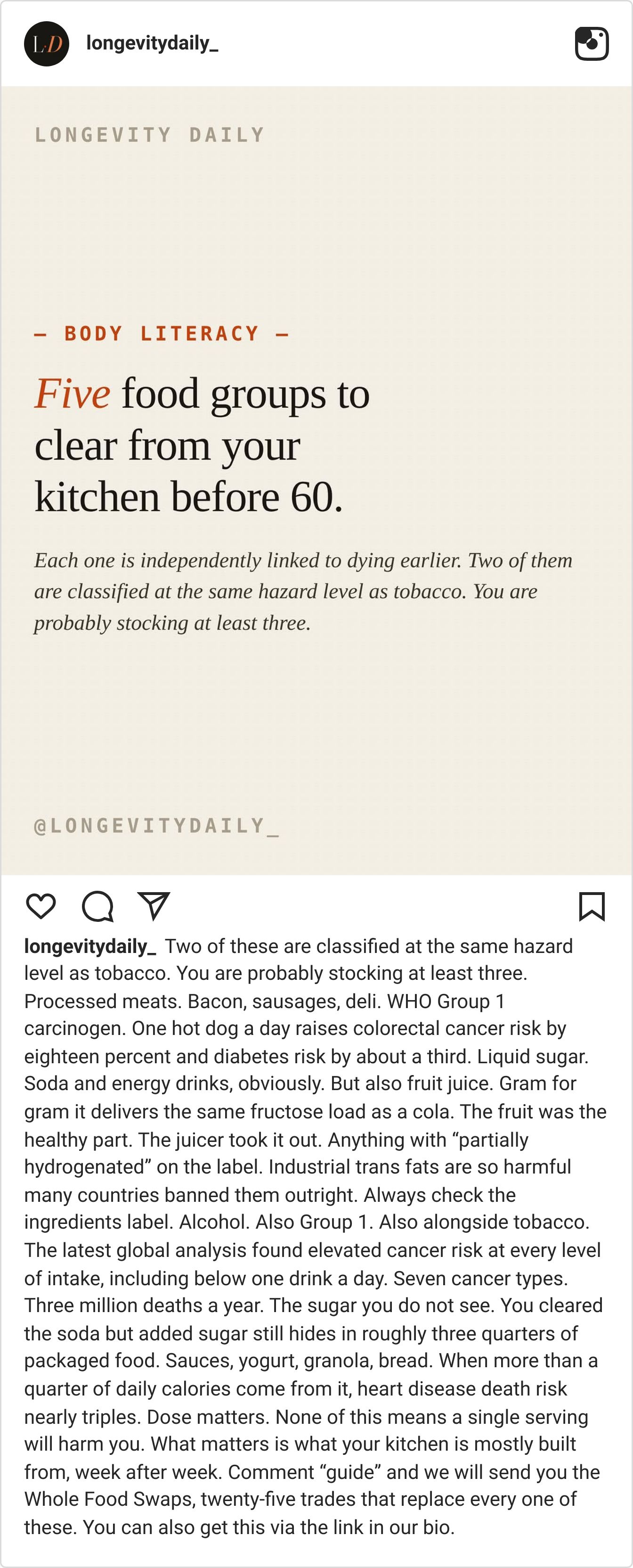
We posted a carousel on Instagram over the weekend naming alcohol as one of five food groups to clear from a kitchen before sixty. It hit 220,000 views and roughly 4,000 comments in less than 48 hours. Between the comments and the DMs, most of the responses landed on the same question. Which is: is this really the same category as tobacco? The formal answer is yes, and understanding why the “alcohol in moderation is healthy” story lasted three decades before it collapsed is worth the five minutes it will take to read the rest of this.
The Instagram post this newsletter is building on:
The evidence
Alcohol has been formally classified as a Group 1 carcinogen by the International Agency for Research on Cancer since 1988. Group 1 is the top hazard tier the agency assigns. It sits alongside tobacco smoke, asbestos, ionising radiation, and processed meat. Group 1 is about hazard, not risk at a given dose, and that distinction is what let the moderation story survive for three decades. Something can be a certain carcinogen in principle and still, at low enough exposures, contribute only a small amount to your absolute lifetime risk. That is the reasonable version of the moderation argument.
The reason it no longer holds up is the 2018 Global Burden of Disease analysis in the Lancet by Griswold and colleagues, which pooled 694 studies covering 28 million adults across 195 countries. The headline finding was that alcohol became the leading global risk factor for premature death in people aged 15 to 49. The minimum-harm dose was zero. Every previous claim of a J-curve, meaning a modest protective effect at one to two drinks a day, was largely explained by what epidemiologists call the sick-quitter problem. Older studies grouped former drinkers and lifelong abstainers together as the reference category, which meant the "abstainer" group included ex-drinkers who had quit because they were already sick with the exact conditions the studies were trying to measure. Compared to that unhealthy reference group, moderate drinkers looked healthier. When Zhao et al's 2023 systematic review in JAMA Network Open corrected for this, the protective effect shrank to nothing.
The WHO Europe statement in January 2023 made the new position explicit and blunt. Elevated cancer risk begins at the first drink for seven cancer types: mouth, throat, larynx, oesophagus, colon, liver, and female breast. The dose-response is linear, not J-shaped, and it does not average out with abstention on other days.
The safe dose is zero. The cardiovascular story was mostly an artefact.

The card names Group 1 tier, seven-plus cancer types, and the WHO 2023 zero-safe-dose threshold.
The strongest case for moderation, and the answer to it
The case for moderation was never really about the alcohol. It was about the wine. Serge Renaud and Michel de Lorgeril's 1992 Lancet paper on the French paradox argued that resveratrol and other polyphenols in red wine explained why French adults had lower cardiovascular mortality than their saturated-fat intake predicted. The Copenhagen City Heart Study extended that observation through the 1990s, and by the mid-2000s the moderate-drinking narrative was the standard cardiology view. That case was not fabricated. It was built on real data.
The confounders were also real. Moderate drinkers in those cohorts were, on average, wealthier, better educated, more physically active, and less likely to smoke than either heavy drinkers or lifelong abstainers. When the newer studies stratified for these variables, and when the sick-quitter problem was corrected, the cardiovascular benefit shrank to near zero. Meanwhile the cancer risk stayed exactly where it was. The polyphenols in wine, if they matter at all, come from the grape skins. You can eat them without the ethanol.
The industry funded a lot of the moderation research, which is a fact rather than a conspiracy claim. Distilled Spirits Council-linked bodies, wine industry councils, and multiple partner-funded studies contributed to the peer-reviewed record for decades. The most visible collapse came in 2018 when the NIH cancelled its Moderate Alcohol and Cardiovascular Health trial, known as MACH, after investigations found the study design had been shaped by alcohol industry involvement. That trial was supposed to be the definitive test of the J-curve. It never ran. What remains after that correction and the newer analyses is straightforward. Alcohol raises cancer risk at any dose. The cardiovascular protection was mostly an artefact of who was drinking. The WHO now says the safe dose is zero, and the peer-reviewed record is aligned with that.
What This Means For You
None of this means a drink at your friend's wedding is going to hurt you. Dose still matters. What you really need to know, and consider, is that one drink a night in your fifties adds roughly one to two extra lifetime cancer cases per hundred people, depending on the cancer type. Three drinks a night runs closer to six to eight, and the mortality contribution starts to compound with liver, pancreatic, and cardiovascular strain. Those are absolute numbers, not the frightening relative risks the headlines run with.
What a lower-risk relationship with alcohol actually looks like. If you drink daily, the single biggest lever is switching to two or three dry nights a week. That alone drops your annual exposure by a third or more, and it is the intervention with the strongest observational support for reversing early liver changes. If you drink socially, the specific brand of alcohol makes less difference than the frequency. A biodynamic natural wine is not really a category. And if you want the pleasurable side of an evening drink without the ethanol, the non-alcoholic wine and aperitif has improved considerably in the last two years.

Recommendation of the week: Thrive Market. The place where we would tell you to shop if you were reworking what’s in your kitchen this month. Thrive screens out partially hydrogenated oils, high-fructose corn syrup, and artificial dyes as a matter of policy.
Their non-alcoholic wine and aperitif selection is well-curated for anyone experimenting with a dry week or a permanent shift.
Wednesday Preview
The healthy drink that is not. Fresh orange juice, cold-pressed included, delivers roughly the same fructose load as a cola. The fibre matrix was the entire mechanism, and the juicer removes it. What that means for your liver, your kids' breakfast, and the post-workout habit. Wednesday.
Reply and tell us what you thought of this newsletter. We love to hear from you.
Until Wednesday.
Longevity Daily · The Building Decades
Share this edition with someone you love.
P.S. If you are running a dry month, or thinking about it, the Meal Framework guide is the practical companion to this week's arc. Six guides, 139 pages, every claim cited. join.longevitydaily.com/guides.